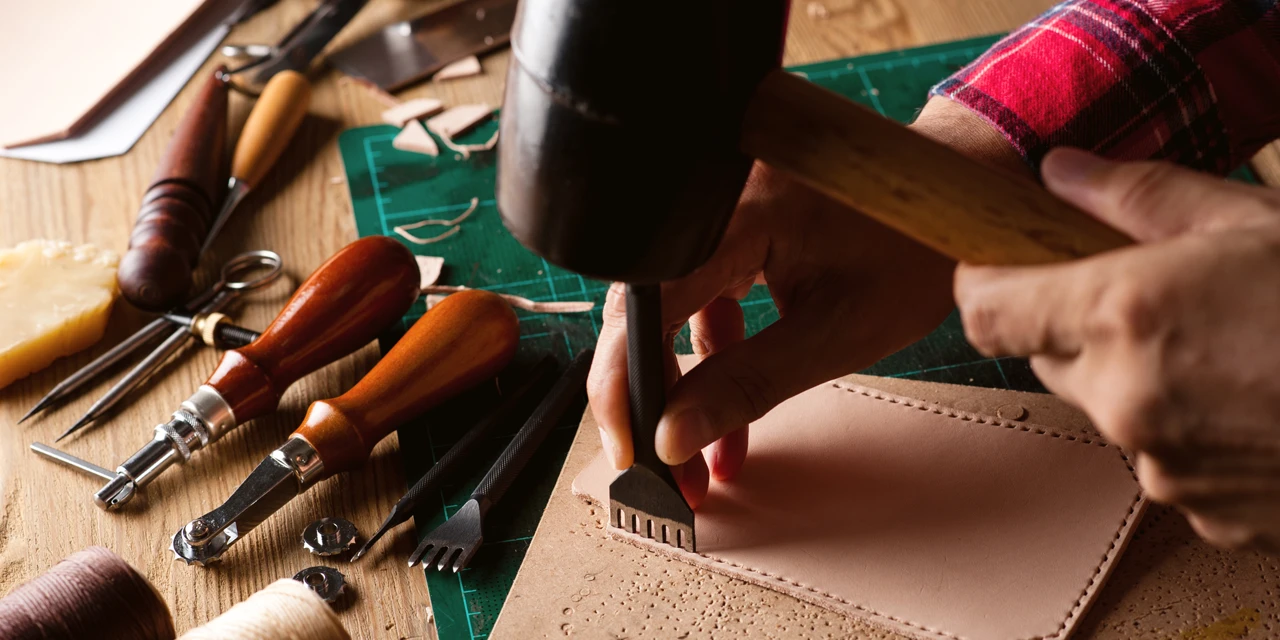
Opening a leather goods business in Geneva, whether a workshop, a shop or a brand that has its pieces made elsewhere, takes no licence and no diploma. What Swiss law regulates is the product. A bag, a belt or a watch strap is a utility article, checked in Geneva by the cantonal Consumer and Veterinary Affairs Service (SCAV), and the business that makes, imports or distributes it must be able to prove that it respects the Swiss limits on chromium VI, azo dyes and nickel. Exotic leathers, common in Geneva’s watch strap trade, add the CITES rules. This guide takes these obligations one by one, with the Geneva details that general guides leave out.
Contents
A free trade with a regulated product
No Swiss law reserves leatherwork for holders of a particular qualification. You choose a legal form, register the company with the Geneva commercial register, and you can open your workshop or shop. The rules that matter apply to what you sell. The Foodstuffs Act classes as utility articles “articles of clothing, textiles and other articles which, when used as normally intended, come into contact with the body” (Art. 5 let. d), and every leather article you make or stock belongs to that group.
What the SCAV expects from you
The Foodstuffs Act places the burden on business, not on the authorities: anyone who manufactures, imports or places utility articles on the market “is obliged to ensure self-supervision” (Art. 26 para. 1). In Geneva, the SCAV spells out what this means for importers, manufacturers and distributors: internal working instructions describing the measures taken, and documents proving the safety of the products, such as analysis results (SCAV page updated on 31 August 2026).
Founders are often surprised by one detail: outside its official controls, the SCAV does not carry out analyses of utility articles for businesses. The reports in your file must therefore come from a private laboratory or, more practically, from your suppliers, provided you ask for them in writing.
The three chemical limits
The Swiss ordinances that set these limits exist only in French, German and Italian. In substance:
- Chromium VI: under the Chemical Risk Reduction Ordinance (ORRChem, version of 16 July 2026), a leather article that comes into contact with the skin may not be placed on the market once its chromium VI content reaches 0.0003% of dry leather weight, which is 3 mg per kilo (Annex 2.16, no. 1bis).
- Azo dyes: the ordinance on articles in contact with the human body (OCCH) prohibits azo dyes that release listed aromatic amines above 30 mg/kg in the leather articles of its Annex 6, which names watch straps, handbags, purses, wallets, briefcases, gloves and shoes (Art. 21).
- Nickel: buckles, clasps, rivets, press studs and zips in direct and prolonged contact with the skin may release no more than 0.5 µg of nickel per cm² per week, and a plating must hold that limit for two years of normal use (OCCH, Art. 2).
For a Geneva workshop, the practical result is one folder per supplier: a chromium VI and amine report for each lot of skins, a nickel test for each hardware reference, and a note linking each lot to the series it was used for.
Your leather goods business in Geneva
A properly structured workshop or shop from day one
Incorporation of the GmbH or AG and registration in Geneva, coordinated trademark filing, accounting for skins, hardware and finished goods, import VAT, workshop payroll: RISTER® sets up and administers your leather goods business so that you can stay at the bench or in the shop.
Request a meeting
RISTER – Fiduciary in Geneva, reply within one business day.
Watch straps for Geneva’s watch houses
In Geneva, a large share of fine leatherwork serves the watch industry. A strap is the most exposed object in the trade: it stays on the wrist all day, often against perspiration. The OCCH covers it twice, for the dyed leather (Annex 6) and for its buckle, since Art. 2 expressly lists watch straps and their clasps among the articles subject to the nickel limit.
Consider an Italian strap maker who settles in Geneva and supplies alligator straps to two watch brands. Like other crocodilians, the alligator falls under CITES: he obtains a permit from the Federal Food Safety and Veterinary Office (FSVO) for every import of skins, keeps a register of the skins received and used, and passes the documents of origin to each watch brand with the straps he delivers. For the tang buckles he supplies, he requires a nickel release test from the manufacturer. The same file later answers the questions a watch brand may ask before listing a new supplier.
Shops that import
A shop on the Rues-Basses selling bags made in Italy or Asia has sewn nothing, yet it is concerned. Self-supervision applies to importers and distributors just as it does to manufacturers, and a shop is where a cantonal inspector is most likely to take a sample. Before ordering, ask each brand or wholesaler for the test reports covering its models, and turn down deliveries from suppliers who cannot provide any.
When the shop imports directly, the file is built at the time of purchase: a contractual clause on the Swiss limits, reports attached to the invoice, and a duty for the supplier to report any change of tannery. This costs less than testing each model in a laboratory, and it is what the SCAV expects to see.
Alligator and python: CITES
Under the Federal Act on the Trade in Protected Species of Fauna and Flora (CITES Act), a bag or strap made from a protected species is itself a protected specimen, as is any item whose label, invoice or packaging indicates such an origin (Art. 3). The rules therefore follow the leather from the raw skin to the customer:
| Stage | Obligation | Article |
|---|---|---|
| Import, transit, export | FSVO permit for species in CITES Appendices I to III, declaration at customs | Art. 6 and 7 CITES Act |
| Holding stock | Documents proving origin and lawful trade | Art. 10 para. 1 |
| Sale | Handing these documents to the buyer | Art. 10 para. 2 |
| Professional trade | Register of specimens | Art. 11 para. 1 |
Source: CITES Act, SR 453, version in force on 13 October 2026.
The trade name of a leather never tells you which rules apply. Check the exact species and its appendix in the Species+ database or with the FSVO before ordering, and make sure your purchase invoices state the species, not only the look.
RISTER advice
Keep the CITES register and the accounting inventory of skins in the same spreadsheet, with the import permit number next to each lot. At year end, the stock of exotic skins can be valued and justified at a glance, and an FSVO inspection does not force you to rebuild the history.
Swiss made
A leather article is an industrial product under trademark law. It may carry the Swiss made label only if at least 60 per cent of its manufacturing costs are incurred in Switzerland (Art. 48c para. 1 Trade Mark Protection Act) and if an essential manufacturing step was carried out here (Art. 48c para. 4). Research, development, materials and manufacturing count; costs after production do not. Depending on the method chosen, skins tanned abroad may count at 0% (Art. 52i Trade Mark Protection Ordinance).
A Geneva workshop that cuts, stitches and assembles its own pieces is often within reach of the label, even with imported skins. A brand that designs in Geneva and has its bags sewn in Italy is not. Our article on starting a manufacturing company in Geneva applies the same rules to production.
Setting up and protecting the brand
A GmbH with CHF 20,000 of fully paid-up capital is enough for most workshops and shops. An AG, with CHF 100,000 of capital of which at least CHF 50,000 is paid up, suits a brand that expects investors or supplies large houses. Our comparison of the GmbH and the AG in Geneva helps you choose.
The Swiss Federal Institute of Intellectual Property (IPI) charges CHF 450 for a trademark valid for ten years and covering up to three classes, with CHF 100 off for online filing. Bags and small leather goods generally go in class 18, watch straps in class 14. Leather articles have entered Switzerland free of customs duties since 1 January 2024, with import VAT at 8.1%. Bookkeeping, VAT and payroll are covered by our general administration service.
FAQ: leather goods business in Geneva
Do you need a licence to open a leather goods business in Geneva?
No. No diploma or licence is required to make, import or sell leather goods; registering the company is enough. The products are utility articles, however, so the manufacturer, importer and distributor must keep a self-supervision file that the SCAV may ask to see.
Which rules apply to leather watch straps?
The dyed leather may not release aromatic amines from azo dyes above 30 mg/kg (OCCH, Art. 21 and Annex 6), the buckle may not release more than 0.5 µg of nickel per cm² per week (OCCH, Art. 2), and the leather must contain less than 3 mg/kg of chromium VI (ORRChem). Exotic straps are also subject to the CITES Act.
Is a Geneva shop responsible for the bags it imports?
Yes. The self-supervision duty covers anyone who imports or places utility articles on the market (Art. 26 Foodstuffs Act), and the SCAV expressly expects it from importers and distributors. In practice, the shop keeps the test reports its suppliers provide.
Do you need a permit to sell python or alligator products?
If the species is listed in CITES Appendices I to III, importing it requires an FSVO permit, and the seller must hold proof of origin, pass it to the buyer and keep a register of specimens (Art. 7, 10 and 11 CITES Act). Check the exact species before buying skins or finished goods.
Which legal form suits a leather goods business in Geneva?
A GmbH with CHF 20,000 of fully paid-up capital suits most workshops and shops. An AG, with CHF 100,000 of capital of which at least CHF 50,000 is paid up, is better suited to a brand taking on investors or supplying the watch industry at scale.
Sources
- State of Geneva, SCAV: self-supervision and analysis of utility articles (31.8.2026, French)
- Foodstuffs Act, SR 817.0
- Ordinance on articles in contact with the human body (OCCH), SR 817.023.41 (French)
- Chemical Risk Reduction Ordinance (ORRChem), SR 814.81 (French)
- CITES Act, SR 453 (French)
- Trade Mark Protection Act, SR 232.11
- Trade Mark Protection Ordinance, SR 232.111
- IPI, trade marks: costs
Conclusion
A leather goods business in Geneva opens without a licence, but not without paperwork. Each bag, belt or watch strap should be traceable to a chromium VI and dye report, each buckle to a nickel test, and each exotic skin to an FSVO permit and a register entry. That file is what the SCAV and the watch houses look for, and it is also what lets you use Swiss made with confidence. RISTER supports Geneva leather workshops, brands and shops with incorporation, then with bookkeeping, VAT and payroll, under a management team with 25 years of experience serving Geneva businesses.