

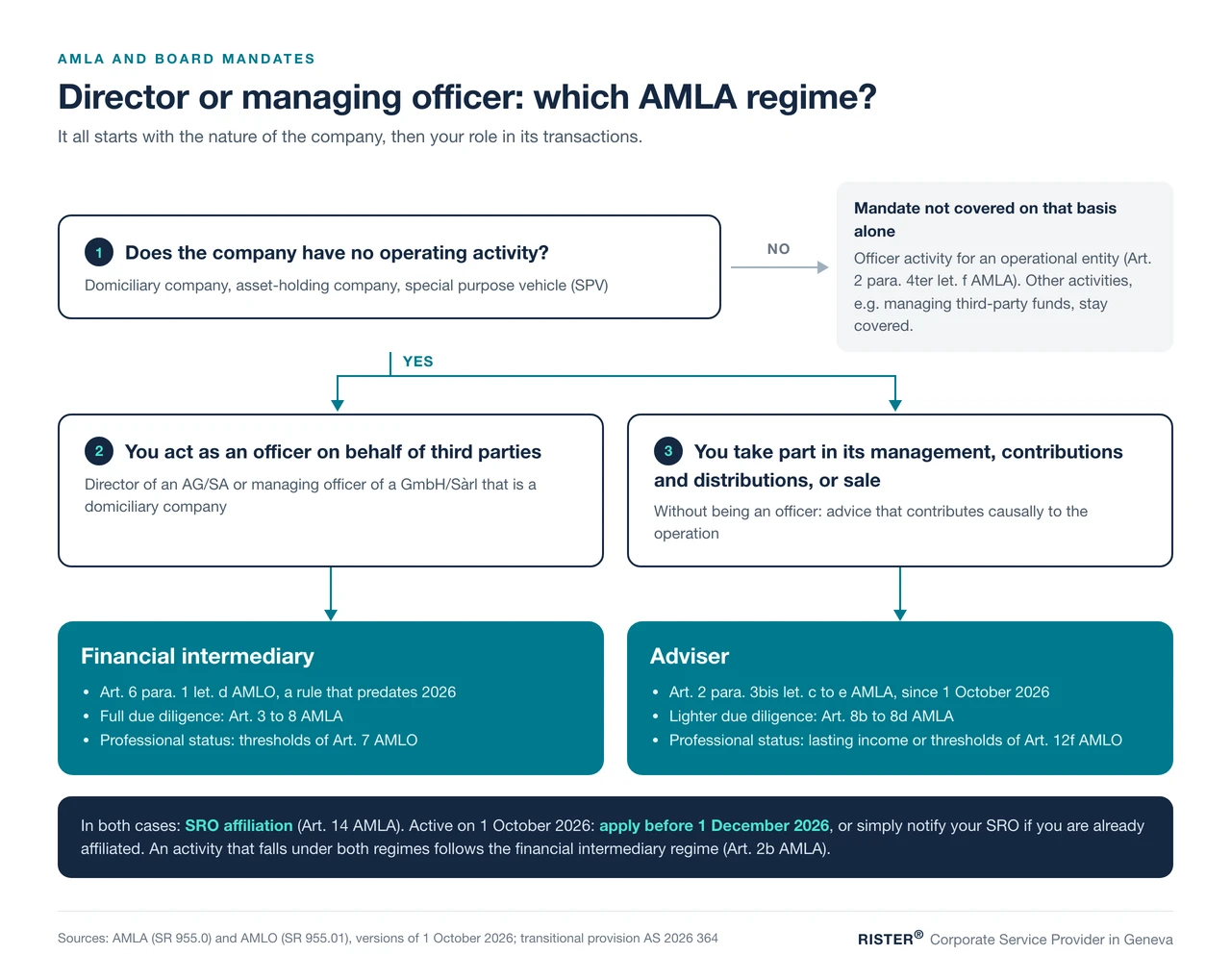
A director or managing officer who sits professionally, on behalf of third parties, on the board of a domiciliary company already falls under the Anti-Money Laundering Act (AMLA): this officer activity is financial intermediation under the Anti-Money Laundering Ordinance (Art. 6 para. 1 let. d AMLO), subject to affiliation with a self-regulatory organisation (SRO). Since 1 October 2026, taking part in the same way in financial transactions linked to managing a non-operational entity also makes you an adviser (Art. 2 para. 3bis let. c AMLA). On its own, a board mandate in an operating company falls outside this regime.
This guide first explains what a domiciliary company is, then assigns each mandate to its regime, with its obligations and deadlines, and ends with an AMLA checklist for directors and managing officers.
Contents
- What is a domiciliary company?
- Directors of a domiciliary company: two AMLA regimes
- Domiciliary company or non-operational legal entity: two AMLA concepts
- Board mandates the AMLA does not cover
- AMLA obligations under each regime
- SRO affiliation, deadlines and penalties
- What the AMLA changes for the company and its shareholder
- AMLA checklist for directors and managing officers before 1 December 2026
- Case studies: three situations, three AMLA regimes
What is a domiciliary company?
A domiciliary company is a company, foundation, trust or similar structure that does not carry on any trading, manufacturing or other commercially run business (Art. 6 para. 2 AMLO). It holds and manages assets, securities, cash or participations, rather than producing or selling anything. It has neither customers nor an operating team, and its presence in Switzerland often amounts to little more than the address of its registered office.
The term carries no stigma. A holding company that pools a family’s assets, a structure that holds a securities portfolio or a vehicle used to pay dividends to a handful of shareholders are entirely lawful domiciliary companies. What changes is the way banks, tax authorities and the AMLA look at them.
How to recognise one
The definition turns on the activity, not the address. The AMLO expressly excludes two categories: structures with a non-commercial purpose (political, religious, scientific, artistic, charitable, recreational) and holding companies that hold majority interests in operating companies without having the management of third-party assets as their main purpose (Art. 6 para. 3 AMLO).
Banks, which must classify every client, rely on indicators such as the absence of own premises and own staff (Art. 39 of the Agreement on the Swiss banks’ code of conduct with regard to the exercise of due diligence, CDB 20). These are only indicators. According to the commentary on CDB 20 published by the Swiss Bankers Association, if the contracting party has its own premises despite a c/o address, “it need not necessarily be classified as a domiciliary company”; in case of doubt, however, the bank treats it as one.
| Situation | Domiciliary company? | Reason |
|---|---|---|
| Active SME with its registered office at a domicile provider | No | It carries on a commercial activity; the c/o address is only an indicator |
| Holding company with majority stakes in active subsidiaries | No | Excluded by Art. 6 para. 3 let. b AMLO |
| Holding company that pools a family’s securities and real estate | Yes | Its role is limited to managing assets (CDB 20 commentary) |
| Pure re-invoicing company | Yes | No operational activity (CDB 20 commentary) |
Sources: AMLO (SR 955.01) Art. 6; Swiss Bankers Association, commentary on CDB 20 (2020), Art. 39.
A domiciled company is not a domiciliary company
The two expressions look alike and mean different things. A domiciled company uses a provider’s address as its registered office: that is a service, and it tells you where the company is registered. A domiciliary company is a legal category, and it describes what the company does. An active Geneva SME can be domiciled with a Corporate Service Provider without being a domiciliary company, and an asset-holding company that rents an office remains a domiciliary company if it carries on no commercial activity. The obligations of the provider that supplies the address are covered in our article on the AMLA and domiciliation.
Neither a synonym for a shell company nor a tax status
A domiciliary company is not necessarily a shell company. That term describes a use, namely a structure designed to conceal its real owner. A lawful structure can be misused for that purpose, and that is precisely what identifying the beneficial owner is meant to prevent. Nor is it a tax regime any longer: the special cantonal statuses, including the domiciliary company status, were abolished on 1 January 2020 by the Federal Act on Tax Reform and AHV Financing (repeal of Art. 28 para. 2 to 4 of the Tax Harmonisation Act, THA). A domiciliary company is now taxed under the ordinary rules of the canton where it has its registered office.
Why the classification matters
- For the AMLA: an officer of a domiciliary company acting on behalf of third parties is a financial intermediary (Art. 6 para. 1 let. d AMLO), with the obligations set out below.
- For the bank: as for any legal entity, it requires a declaration naming the beneficial owner (Art. 4 para. 2 let. b AMLA), but it examines the domiciliary company with particular care.
- For the tax authorities: a structure whose decisions are in fact taken abroad may be claimed by the tax authority of the country where its managers live, on the basis of its place of effective management. The company’s substance and the reality of its board of directors in Switzerland are not formalities.
Directors of a domiciliary company: two AMLA regimes
The AMLA reaches the director or managing officer of a domiciliary company by two routes. The older one treats them as a financial intermediary; the other, opened on 1 October 2026, makes them an adviser. Both require affiliation with an SRO, but they do not impose the same obligations.
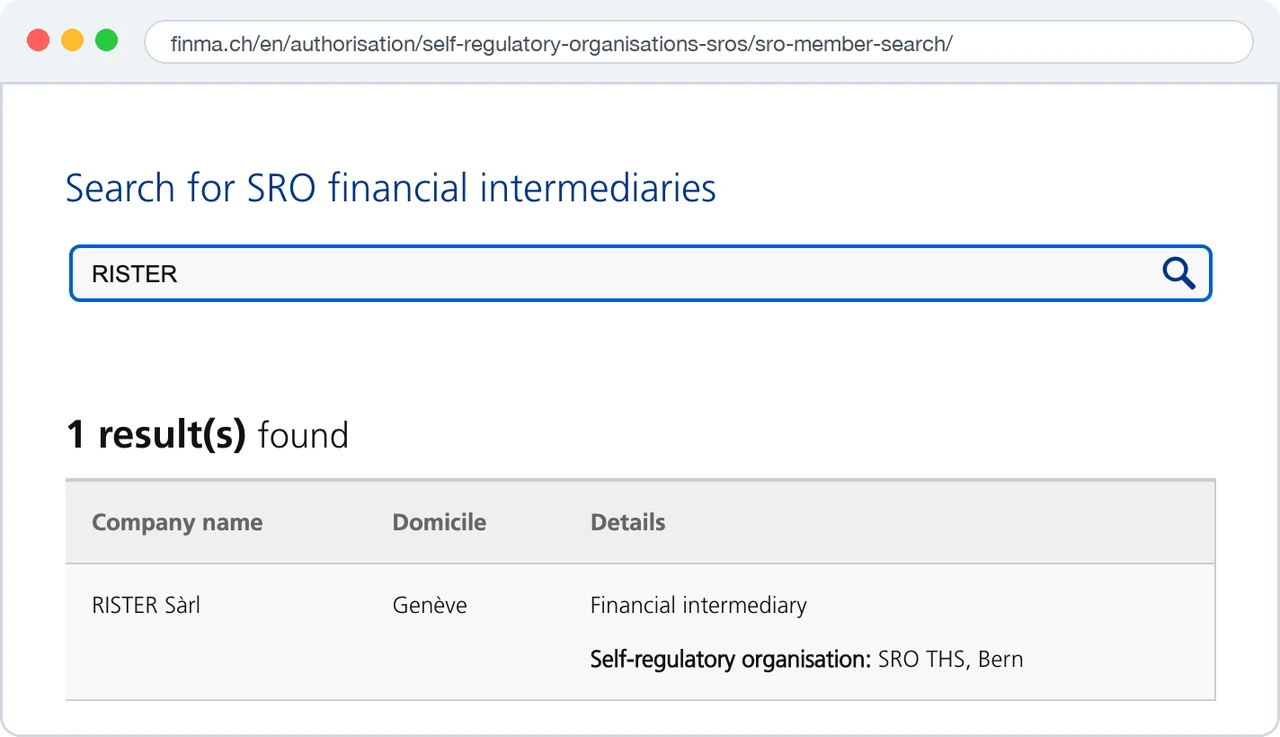
RISTER®, a Geneva Corporate Service Provider that holds director and managing officer mandates, appears in FINMA’s SRO member search as a financial intermediary affiliated with OAR FIDUCIAIRE|SUISSE. The rules below are presented from that standpoint, as a practitioner subject to the Act.
The officer of a domiciliary company as a financial intermediary
Art. 6 para. 1 let. d AMLO lists among the activities of a financial intermediary, “provided that they are carried out on behalf of third parties”, “the activity as an officer of domiciliary companies” (unofficial translation; the binding versions are German, French and Italian). The rule predates the revision: a director of a company limited by shares (AG/SA) or a managing officer of a limited liability company (GmbH/Sàrl) who held such mandates on a professional basis already had to be affiliated with an SRO.
Professional status is measured under Art. 7 AMLO: more than CHF 50,000 of gross revenue per calendar year, lasting business relationships with more than 20 contracting parties, or at least 20 such relationships maintained during the calendar year, power of disposal over more than CHF 5 million belonging to third parties, or more than CHF 2 million of transactions a year. A single criterion is enough.
The adviser to a non-operational entity, since 1 October 2026
The amendment to the AMLA of 26 September 2025 (AS 2026 322) creates the category of advisers. Art. 2 para. 3bis AMLA covers “legal entities and natural persons who, on a professional basis, take part on behalf of third parties in financial transactions, including the organisation of funds” in connection with five types of operation. Three of them bear directly on board mandates:
- “the management or administration of a non-operational legal entity” (let. c);
- “the contributions and distributions of a non-operational legal entity” (let. d);
- “the sale or purchase of a legal entity where the sale or purchase takes place through a non-operational legal entity” (let. e).
Taking part is understood broadly: it includes “any advice that contributes causally” to the operation (Art. 12d AMLO). A seat on the board is therefore not required. A consultant who organises a dividend distribution for a non-operational structure can be an adviser without ever being entered in the commercial register as an officer.
| Criterion | Officer of a domiciliary company | Adviser (non-operational entity) |
|---|---|---|
| Legal basis | Art. 2 para. 3 AMLA, Art. 6 para. 1 let. d AMLO | Art. 2 para. 3bis let. b to e AMLA |
| In force | Before the revision | Since 1 October 2026 |
| Trigger | Acting as an officer on behalf of third parties | Taking part in a financial transaction, as an officer or not |
| Professional status | Art. 7 AMLO | Art. 12f AMLO |
| Due diligence | Art. 3 to 8 AMLA | Art. 8b to 8d AMLA |
| Reporting to MROS | Art. 9 para. 1 AMLA | Art. 9 para. 1ter AMLA |
| SRO affiliation | Mandatory (Art. 14 para. 1) | Mandatory (Art. 14 para. 1) |
Source: AMLA (SR 955.0) and AMLO (SR 955.01), versions in force since 1 October 2026, Fedlex.
When the two regimes overlap
Where the same activity falls under both financial intermediation and advice, the rules for financial intermediaries apply (Art. 2b para. 1 AMLA). That is typically the case of the director of a domiciliary company: their board mandate, carried out on behalf of third parties, is both financial intermediation (Art. 6 para. 1 let. d AMLO) and participation in the administration of a non-operational entity. They therefore remain subject to Art. 3 to 8. What decides is the nature of the activity carried on, not an isolated element such as bank signing authority. Someone who carries on separate activities of both kinds follows the rules for each, unless they declare that everything is subject to the rules for financial intermediaries (Art. 2b para. 2 AMLA). And the SRO that supervises them as a financial intermediary supervises all their activities (Art. 12a para. 2 AMLA).
Domiciliary company or non-operational legal entity: two AMLA concepts
The two concepts overlap without being the same. The domiciliary company is defined by the AMLO, as we have just seen; the non-operational legal entity, which triggers the adviser regime, is defined by the Act itself, in Art. 2a para. 6 AMLA.
The non-operational legal entity under Art. 2a para. 6 AMLA
The provision covers “legal entities, companies, institutions, foundations, trusts, trust companies or other similar relationships that were not set up or managed for the purpose of carrying on or supporting the operational activities of a business or group, in particular domiciliary companies” (Art. 2a para. 6 AMLA).
This concept encompasses domiciliary companies, but its scope does not necessarily coincide with that of Art. 6 AMLO: the Act looks at the purpose for which the structure was set up or is managed, the AMLO at the absence of commercial activity, subject to express exclusions. Classification therefore turns on the structure’s actual activity, and the SROs refine the practice: ARIF cites domiciliary companies, pure holding companies and special purpose vehicles (SPVs). The gap lies mainly in holding companies: one that holds a majority stake in active subsidiaries is not a domiciliary company and, if it supports its group’s activities, is not a non-operational entity either; one that merely holds passive assets in principle falls under both concepts.
| Structure | Domiciliary company (Art. 6 AMLO) | Non-operational entity (Art. 2a para. 6 AMLA) |
|---|---|---|
| Commercial company limited by shares with employees and customers | No | No |
| Holding company with majority stakes in active subsidiaries | No (para. 3 let. b) | In principle no, if it supports the group’s activities |
| Holding company holding only a securities portfolio | Yes | Yes |
| Operational public-benefit foundation | No (para. 3 let. a) | No; officer activity excluded if the registered office is in Switzerland (Art. 2 para. 4ter let. f AMLA) |
Sources: AMLO (SR 955.01) Art. 6; AMLA (SR 955.0) Art. 2 para. 4ter and Art. 2a para. 6; ARIF, AML Advisors FAQ. Classification to be established case by case, based on the actual activity.
RISTER advice
Record how each structure is classified when you accept the mandate, and again whenever its activity changes: headcount, turnover, nature of the assets, membership of a group. A holding company that sells its subsidiaries and keeps the proceeds in cash does not automatically change category, but its classification must be reassessed in the light of its activity and of the purpose of the assets it holds: the AMLA regime of its officers may depend on it.
Board mandates the AMLA does not cover
The Act expressly excludes “activities as an officer of operational legal entities or of public-benefit foundations or operational associations having their registered office in Switzerland” (Art. 2 para. 4ter let. f AMLA). The resident director of an active Geneva SME is therefore not an adviser merely by virtue of the mandate.
Three further limits narrow the scope of advice:
- Services within a group do not make the provider an adviser (Art. 2 para. 3 let. a AMLO).
- Family transactions: those governed by family law, matrimonial property law, inheritance law or a gift, or between persons who are related within the meaning of Art. 2 para. 2 let. a of the Financial Institutions Act (FinIA) (Art. 2 para. 4ter let. a AMLA).
- Occasional activity: advice is professional only if it amounts to an independent economic activity aimed at a lasting income. It is professional in any event above one of the thresholds of Art. 12f para. 1 AMLO (more than CHF 50,000 of gross revenue, more than 20 clients or more than 20 transactions per calendar year, more than CHF 5 million of third-party assets, more than CHF 2 million of transactions), whether it is the main activity or an ancillary one (Art. 12f para. 2 AMLO).
Important
The exclusion in Art. 2 para. 4ter let. f concerns the adviser regime. A director of an operating company who also manages funds or securities on behalf of third parties remains a financial intermediary for that activity.
AMLA obligations under each regime
The officer of a domiciliary company applies the full financial intermediary regime; the adviser, a lighter regime centred on the service provided. In both cases, the AMLA comes on top of company law and relaxes none of its requirements.
Officer of a domiciliary company: the financial intermediary regime
- Identify the contracting party and the persons acting on its behalf (Art. 3), then the beneficial owner, with a written declaration, or one that can be evidenced by text, where the contracting party is a domiciliary company or an operating legal entity (Art. 4 para. 2 let. b); repeat these checks if doubts arise (Art. 5).
- Understand the nature and purpose of the relationship, and clarify any unusual transaction, any indication of criminal origin and any higher risk. A relationship with a foreign politically exposed person always carries a higher risk (Art. 6).
- Document and keep records for ten years (Art. 7), organise and train staff (Art. 8).
- Report to the Money Laundering Reporting Office Switzerland (MROS) where there are reasonable grounds for suspicion (Art. 9 para. 1), freeze the assets entrusted in the cases provided for (Art. 10), without informing the client (Art. 10a para. 1).
Adviser: the Art. 8b regime
The adviser verifies the client’s identity, identifies the beneficial owner and keeps records (Art. 8b para. 1). They establish the nature and purpose of the service (para. 2) and clarify its background only where the risk requires it (para. 3), according to criteria set by their SRO (Art. 8c). They take the organisational measures of Art. 8d, report suspicions to MROS (Art. 9 para. 1ter), say nothing to the client (Art. 10a para. 5) and answer requests from the reporting office (Art. 11a). The Act allows them to end the mandate at any time after a report (Art. 9b para. 2bis).
Company law still applies in full
The non-transferable duties and the duties of care and loyalty remain those of the Swiss Code of Obligations (CO): Art. 716a and 717 CO for the board of directors, Art. 810 and 812 CO for managing officers. The company must always be capable of being represented by a person resident in Switzerland (Art. 718 para. 4 CO for a company limited by shares, Art. 814 para. 3 CO for a limited liability company). These responsibilities are discussed in our articles on the role of the director of a Swiss company and on the duties of the manager of a limited liability company.
SRO affiliation, deadlines and penalties
Every financial intermediary within the meaning of Art. 2 para. 3 AMLA and every adviser must join an SRO (Art. 14 para. 1 AMLA). For those already acting as advisers on 1 October 2026, the application or notification must be filed before 1 December 2026.
| Your situation | Step | Deadline |
|---|---|---|
| Already affiliated as a financial intermediary and also acting as an adviser | Notify your SRO of the adviser activity | Before 1 December 2026 |
| Adviser active on 1 October 2026, not affiliated | Apply for affiliation; until the decision, existing business relationships only | Before 1 December 2026 |
| New adviser, or threshold crossed during the year | Obligations apply immediately; apply for affiliation | Two months (Art. 12g AMLO) |
| Resignation or exclusion from an SRO | Apply to another SRO | Two months (Art. 12h AMLO) |
Source: AMLO (SR 955.01), Art. 12g, 12h and transitional provision of the amendment of 26 September 2025 (AS 2026 364).
The SRO examines the internal organisation, the reputation of the applicant and its managers, and that of holders of qualifying participations (Art. 14 para. 2 AMLA). Once affiliated, the person appears in the public register of financial intermediaries and advisers kept by FINMA (Art. 18b AMLA), which clients and their banks can consult.
Wilfully carrying on an activity that requires SRO affiliation without being affiliated is punishable by a custodial sentence of up to three years or a monetary penalty, and negligence by a fine of up to CHF 250,000 (Art. 44 of the Financial Market Supervision Act, FINMASA). Failing to report a well-founded suspicion is punishable, where wilful, by a fine of up to CHF 500,000 (Art. 37 AMLA).
What the AMLA changes for the company and its shareholder
For the shareholder of a domiciliary company, the AMLA means a fuller acceptance file and regular updates. A director who asks for nothing is not offering flexibility: they are heading for a resignation at their SRO’s first inspection.
- When the mandate is accepted: identity documents, beneficial owner declaration, an explanation of the structure’s purpose and, under the financial intermediary regime or where the risk is high, of the source of funds.
- During the mandate: periodic updating of documents according to risk (Art. 7 para. 1bis AMLA) and justification of unusual transactions.
- With the transparency register: the company reports its beneficial owners to the transparency register created by the Federal Act on the Transparency of Legal Entities (LTPM), which financial intermediaries and advisers can consult online (Art. 27 LTPM). From 1 April 2027 (Art. 54 LTPM), a director acting as a financial intermediary will have to report to the register, within 30 days, any discrepancy liable to cast doubt on the information about the beneficial owner that persists after you have been given a reasonable period to correct it (Art. 30 LTPM).
Our resident director and managing officer service in Switzerland starts with this analysis: classification of the company, applicable AMLA regime, documents to gather.
AMLA checklist for directors and managing officers before 1 December 2026
- List your board mandates and your advisory work on structures: company, canton, actual activity, nature of the assets.
- Classify each structure: operational, domiciliary company, non-operational entity, group holding company.
- Assign each mandate to a regime: financial intermediary, adviser or excluded officer activity (Art. 2 para. 4ter let. f), subject to your other activities.
- Measure the thresholds of Art. 7 or Art. 12f AMLO over the calendar year.
- Check your status with an SRO: already affiliated (notification of the adviser activity) or not (application for affiliation).
- Bring your files up to standard: identity, beneficial owner declaration, nature and purpose, risk profile, for every current mandate.
- File the notification or application before 1 December 2026 and keep proof of filing.
Resident director or managing officer in Geneva
A board mandate with a Corporate Service Provider affiliated with an SRO
Looking for a resident director or managing officer? RISTER, a financial intermediary affiliated with OAR FIDUCIAIRE|SUISSE, provides one, with the AMLA classification of your company from the moment the mandate is accepted and the same contact person for accounting, VAT and tax.
Request a meeting
RISTER – Corporate Service Provider in Geneva, reply within one business day.
Case studies: three situations, three AMLA regimes
Three situations common in French-speaking Switzerland show that the same role of director can fall under three different regimes.
Geneva: the resident director of a trading company
A Geneva trading company limited by shares employs twelve people and invoices European customers. Its resident director, appointed by the foreign shareholder, has no other role. The company is operational, so the mandate is excluded by Art. 2 para. 4ter let. f AMLA. The Code of Obligations applies in full; the AMLA, as far as this mandate is concerned, does not.
Geneva: the family holding company that holds only securities
A Geneva holding company holds a securities portfolio and cash for a family living abroad, with no active subsidiary. It is a domiciliary company within the meaning of Art. 6 para. 2 AMLO, and its director, appointed by the family, acts as an officer on behalf of third parties. With 25 mandates of this kind, the director exceeds the threshold of 20 relationships in Art. 7 AMLO: they are a financial intermediary and already had to be affiliated with an SRO before 1 October 2026.
Lausanne: the consultant who organises an SPV’s exit
A Lausanne consultant who sits on no board organises, for a client, the dividend distribution of an SPV, a vehicle with no operating activity that holds a building, followed by the sale of its shares. The distribution falls under Art. 2 para. 3bis let. d AMLA, and the sale of the shares of a real estate company under let. a, which covers legal acts having the same economic effects as a sale of real estate (Art. 12e para. 2 let. a AMLO). Unless the price is below CHF 5 million and passes exclusively through banks (Art. 2 para. 4ter let. b AMLA), a single sale of more than CHF 2 million makes the consultant’s advice professional (Art. 12f para. 1 let. d AMLO): as they were active on 1 October 2026, they must apply for SRO affiliation before 1 December 2026.
FAQ: AMLA, directors and managing officers of domiciliary companies
What is a domiciliary company?
A domiciliary company is a company, foundation, trust or similar structure that carries on no trading, manufacturing or other commercially run business (Art. 6 para. 2 AMLO): it holds and manages assets, such as a family’s wealth. Holding companies with majority interests in operating companies and structures with a non-commercial purpose are excluded (Art. 6 para. 3 AMLO). The concept is lawful: a domiciliary company is not necessarily a shell company and, since 1 January 2020, it is no longer a tax status.
Must the director of a domiciliary company be affiliated with an SRO?
Yes, if they act on a professional basis and on behalf of third parties. Acting as an officer of domiciliary companies is financial intermediation (Art. 6 para. 1 let. d AMLO), subject to affiliation with a self-regulatory organisation (Art. 14 para. 1 AMLA). Professional status is reached as soon as one of the thresholds of Art. 7 AMLO is met, for example more than CHF 50,000 of gross revenue or at least 20 lasting business relationships per calendar year.
Is the director of an operating company subject to the AMLA?
Not by virtue of the board mandate. Art. 2 para. 4ter let. f AMLA excludes activities as an officer of operational legal entities, public-benefit foundations and operational associations with their registered office in Switzerland. The director remains subject to the AMLA for any other activity that falls under it, such as managing third-party funds.
Is the managing officer of a GmbH/Sàrl affected in the same way as the director of an AG/SA?
Yes. The AMLA targets the activity of an officer and the management or administration of an entity, whatever its legal form: the managing officer of a limited liability company that is a domiciliary company is an officer in exactly the same way as the director of a company limited by shares. The thresholds, the obligations and the 1 December 2026 deadline are identical.
What is the difference between a domiciliary company and a non-operational legal entity?
A domiciliary company is defined by Art. 6 para. 2 AMLO: a structure with no trading, manufacturing or other commercially run business, holding companies with majority interests in operating companies being excluded. The non-operational legal entity is defined by Art. 2a para. 6 AMLA: a structure that was not set up or managed to carry on or support the operational activities of a business or group, in particular a domiciliary company. The two concepts overlap widely without being identical, and classification depends on the structure’s actual activity.
Is a holding company a domiciliary company under the AMLA?
Not necessarily. A holding company that holds majority interests in operating companies, without managing third-party assets, is not a domiciliary company (Art. 6 para. 3 let. b AMLO). A holding company that holds only securities or cash is in principle one. Its director then falls under the financial intermediary regime if they hold that mandate on behalf of third parties and on a professional basis, that is, above one of the thresholds of Art. 7 AMLO.
What are the new AMLA measures in 2026?
Since 1 October 2026, the AMLA has applied to a third category, advisers: professional involvement, on behalf of third parties, in financial transactions connected with the sale or purchase of real estate, the formation, management or administration of non-operational entities, their contributions and distributions or the sale of an entity through such a structure, as well as domiciliation for more than six months. Advisers active on 1 October 2026 must apply for SRO affiliation before 1 December 2026; if they are already affiliated with an SRO as financial intermediaries, they notify it of this activity within the same deadline.
What are the penalties for holding a mandate without affiliation?
Wilfully carrying on an activity that requires SRO affiliation without being affiliated is punishable by a custodial sentence of up to three years or a monetary penalty, and by a fine of up to CHF 250,000 in case of negligence (Art. 44 FINMASA). Wilfully failing to report to MROS is punishable by a fine of up to CHF 500,000 (Art. 37 AMLA).
Sources
- Anti-Money Laundering Act (AMLA, SR 955.0), version in force since 1 October 2026: Art. 2, 2a, 2b, 3 to 10a, 11a, 12a, 14, 18b, 37 (official French version)
- Amendment of the AMLA of 26 September 2025 (AS 2026 322, official French version)
- Anti-Money Laundering Ordinance (AMLO, SR 955.01): Art. 2, 6, 7, 12d to 12h and transitional provision (official French version)
- Ordinance of 12 June 2026 on the Transparency of Legal Entities, Annex No. 6: amendment of the AMLO and transitional provision (AS 2026 364, official French version)
- Federal Act on the Transparency of Legal Entities (LTPM, SR 955.3): Art. 27, 30 and 54 (official French version)
- Financial Market Supervision Act (FINMASA, SR 956.1): Art. 44 (official French version)
- Tax Harmonisation Act (THA, SR 642.14): Art. 28 para. 2 to 4 repealed on 1 January 2020, Art. 78g (official French version)
- Swiss Code of Obligations (CO, SR 220): Art. 716a, 717, 718, 810, 812, 814 (official French version)
- FINMA: combating money laundering
- FINMA: SRO member search (consulted on 8 October 2026)
- Swiss Bankers Association: commentary on CDB 20 (2020), Art. 39 on domiciliary companies (in French)
- ARIF: AML Advisors FAQ (in English)
Conclusion
The question is no longer simply whether you are an officer of a domiciliary company, but whether the structure is operational and what role you play in its transactions. The answer determines the regime, financial intermediary or adviser, and the 1 December 2026 deadline leaves little time to classify each mandate.
RISTER, a Geneva Corporate Service Provider affiliated with OAR FIDUCIAIRE|SUISSE, holds director and managing officer mandates under the direction of Andrés Taracido, an expert with more than 25 years of experience serving Swiss businesses. To review the AMLA regime of your structures, contact our experts.