
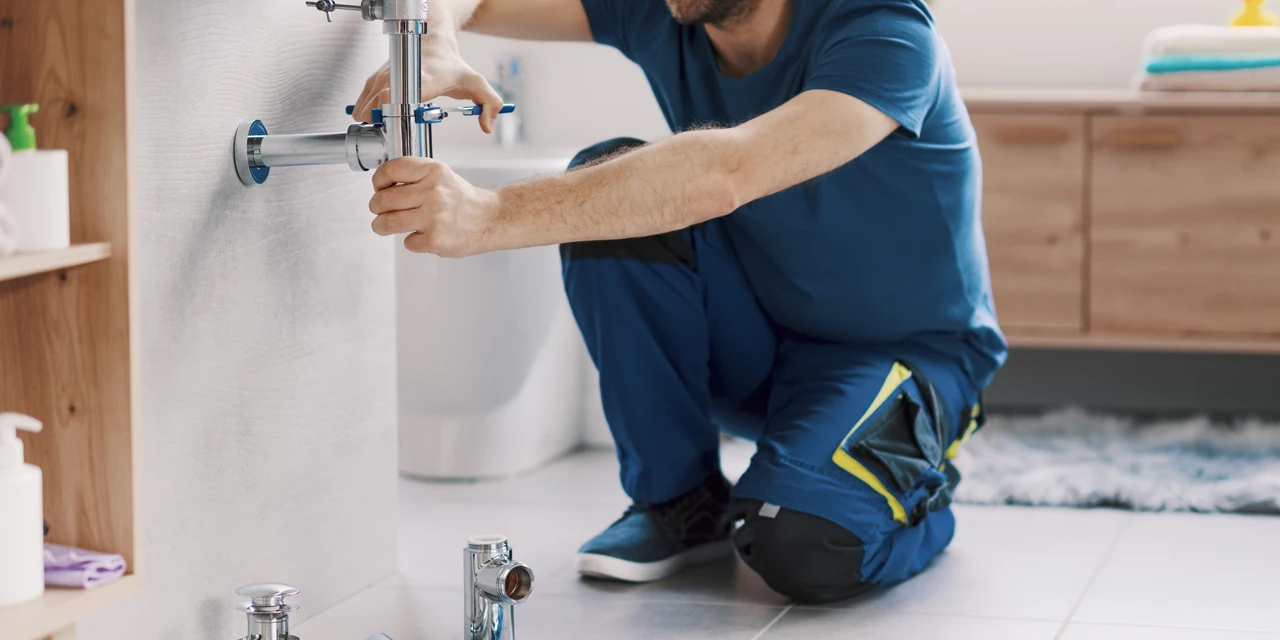
When you start a plumbing company in Geneva, your first counterpart is not the commercial register but the Services Industriels de Genève (SIG). There is no federal licence for sanitary installers, yet in Geneva a gas installation may only be installed, altered or repaired by an installer authorised by SIG, and every water installation is notified to them. Since 1 July 2026 a renewed Geneva collective agreement also applies, your workers must be insured with Suva, and two rules protect your invoices: the 60-day notice period for defects and the builders’ lien. This guide covers them from the point of view of a company setting up in Geneva, whether founded by a local installer, an expatriate or a firm from neighbouring France.
Contents
- SIG before the first job
- The certified installer attestation
- The Geneva collective agreement extended in 2026
- Hiring: cross-border staff, Suva, early retirement
- Repair work in Geneva from France
- Defects: the 60-day rule
- Securing your invoice: the builders’ lien
- Incorporating in Geneva
- Common pitfalls
- FAQ
SIG before the first job
In Geneva, the rules of the trade start with the utility. For gas, the SIG regulation leaves no room for interpretation: private installations may only be established, altered or repaired by installers holding an authorisation issued by SIG (Art. 27(1), version of 1 June 2020). Users may not let anyone without SIG authorisation work on their installation (Art. 27(2)), and no new or altered installation is commissioned before SIG has inspected it (Art. 28(1)). SIG publishes the list of approved gas installers and engineering offices.
For water, the SIG installation rules that supplement the SVGW W3 guideline (version of 1 August 2024) make the sanitary installer responsible for choosing and fitting the backflow protection device, informing the client of its mandatory maintenance, and notifying SIG of the installation. They also contain detailed rules for meter assemblies and valves that a newcomer must know before quoting.
The certified installer attestation
The Canton of Geneva, on its page on sanitary installers’ duties (updated 6 May 2025), recommends that every professional working on drinking water installations hold the certified installer attestation issued by SVGW (SSIGE). It also reminds installers to use only materials certified for contact with drinking water, to follow the SVGW W3 guideline and its supplements, and to apply the federal health and food safety offices’ recommendations on legionella.
Under SVGW regulation GW 101, the attestation requires a Swiss federal VET diploma as sanitary installer and at least two years of experience, or an upper secondary qualification and four years, plus SVGW training. It is valid for five years and listed in a register utilities consult. If you trained abroad, check recognition of your diploma first: otherwise the certified person will have to be an employee.
The Geneva collective agreement extended in 2026
Plumbers in Geneva are outside the national building services agreement, which expressly excludes Geneva, Vaud and Valais. They fall under the collective agreement for technical building trades in the Canton of Geneva, signed on 19 November 2025. The cantonal government extended its scope by a decree of 20 May 2026, in force since 1 July 2026 and effective until 31 December 2030.
The extension covers every employer carrying out the installation, repair, troubleshooting, maintenance or technical cleaning of building services in the canton, including plumbing with pipework, burners and tanks, as well as heating, ventilation, sheet metal and electrical work. Key rules for a new employer:
| Topic | Geneva agreement | Article |
|---|---|---|
| Contract | Signed written agreement, copy handed to the worker before starting | Art. 10(1)-(2) |
| Early retirement | Every hire notified to the early-retirement fund before the first working day | Art. 10(4) |
| Working time | 40 hours a week; hours beyond paid at 125 per cent | Art. 11(1) |
| Holidays | 22 days from age 20; 27 days under 20, from 50 or after 25 years in the trade; 32 days from 60 | Art. 23 |
| Contributions | Enforcement costs and professional contribution | Art. 36 and 37 |
Source: decree of the Geneva Council of State of 20 May 2026 extending the collective agreement for technical building trades, with the agreement annexed.
Minimum wages are set in the agreement’s annex according to each worker’s qualification; they are the starting point of your hourly rate.
Your plumbing company in Geneva
A compliant structure before you apply to SIG
Incorporation of the GmbH (Sàrl) or AG (SA) and entry in the Geneva commercial register, registration with Suva, the compensation fund and the sector’s early-retirement fund, payroll under the Geneva agreement, job costing and deposit tracking: RISTER® sets up and runs your company so you can focus on installations.
Request a meeting
RISTER – Fiduciary in Geneva, reply within one business day.
Hiring: cross-border staff, Suva, early retirement
Geneva plumbing firms often employ installers who live in France. Their contracts follow the Geneva agreement like those of residents, and each hire is notified to the early-retirement fund before day one. For accident insurance there is no choice: workers in building, installation and pipe-laying companies are compulsorily insured with Suva under the Federal Accident Insurance Act.
Take a British plumber settled in Geneva who forms a GmbH in Plan-les-Ouates with one cross-border employee. Before the first gas job, he obtains SIG authorisation. Before his employee’s first day, he notifies the early-retirement fund and hands over a written contract stating the role, wage, 40-hour week and the applicability of the agreement. Suva covers the employee. None of this requires a permit, and all of it is checked in a joint commission inspection.
Repair work in Geneva from France
Many firms from Haute-Savoie and the Ain work in Geneva before setting up there. The Posted Workers Act requires a written notice before each assignment, in the official language of the place, with the identity and wages of posted workers, the activity and the location (Art. 6(1)), and work may start only eight days after the notice (Art. 6(3)). In the finishing trades, notice is due whatever the duration (Art. 6(2)(a) of the Posted Workers Ordinance).
Emergency repair is the exception: in urgent cases such as repairs, accidents, natural disasters or other unforeseeable events, work may begin before the eight days, but no earlier than the day of the notice (Art. 6(3) of the Ordinance). A leak in Champel can therefore be fixed the same day by a firm from Annemasse, provided notice is filed that day. The Geneva agreement applies to posted workers during the assignment (Art. 2 of the Act).
Defects: the 60-day rule
Since 1 January 2026, the Code of Obligations gives construction clients more protection, and that should shape your terms before you incorporate. For work on immovable property, which a sanitary installation is, the client has 60 days to report defects found on acceptance, and a shorter contractual period is void (Art. 367(1bis) CO). Hidden defects must be reported within 60 days of discovery (Art. 370(4) CO). Any clause agreed in advance that restricts or excludes the right to repair is void where the defect concerns a building (Art. 368(2bis) CO), and claims become time-barred only after five years from acceptance (Art. 371(2) CO).
The practical answer is a written, dated acceptance record for every installation: it starts the clock and helps distinguish an original defect from later damage.
Securing your invoice: the builders’ lien
The Civil Code gives tradesmen security over the building itself, “whether the debtor is the owner of the property, tradesman or building contractor, tenant or any other person with rights to the property” (Art. 837(1)(3) CC). “Application for such entry must be made within four months of completion of the work” (Art. 839(2) CC); the amount must be recognised by the owner or set by a judge.
- Commercial tenants refitting the washrooms of a shop or restaurant: the lien is available only if the owner consented to the work (Art. 837(2) CC). Get that consent in writing before starting.
- Subcontractors of a general contractor: your lien attaches to the client’s building even without a contract with the owner, and “the beneficiary may not waive such statutory mortgage rights in advance” (Art. 837(3) CC), whatever your subcontract says.
RISTER advice
Record a completion date for every job and track payments job by job. When a client is late, the four months run from that date; bookkeeping that follows receivables per site lets you decide in time whether to act.
Incorporating in Geneva
A GmbH (Sàrl) with CHF 20,000 of fully paid-in capital suits most plumbing firms starting with one or two partners; an AG (SA), with CHF 100,000 of capital of which at least CHF 50,000 is paid in, fits a growing firm bidding for larger contracts. Our GmbH or AG comparison for Geneva and our checklist to set up a company in Geneva cover the steps.
If you also take on structural work, the main construction sector rules are in our guide to a construction company in Geneva; if you add electrical work, the federal authorisation is explained in our guide to an electrical company in Geneva.
Common pitfalls
- Accepting gas work before SIG has authorised you.
- Forgetting to notify SIG of a water installation, or to inform the client about backflow device maintenance.
- Applying the national agreement in Geneva, which it excludes.
- Hiring without notifying the early-retirement fund first.
- Keeping terms that shorten the notice period for defects, void since 1 January 2026.
- Working for a tenant without the owner’s written consent, and losing the lien.
FAQ: starting a plumbing company in Geneva
Do you need SIG authorisation to install gas in Geneva?
Yes. The SIG regulation provides that private gas installations may only be established, altered or repaired by installers holding an SIG authorisation (Art. 27(1)), and no new or altered installation is commissioned before SIG inspection (Art. 28(1)). For water, the installer notifies SIG of the installation and is responsible for the backflow protection device.
Which collective agreement applies in Geneva?
The collective agreement for technical building trades in the Canton of Geneva, extended by the cantonal government on 20 May 2026 with effect from 1 July 2026 to 31 December 2030. The national building services agreement does not apply in Geneva. The Geneva agreement sets a 40-hour week and requires notice of every hire to the early-retirement fund before the first day.
Can a French company do repair work in Geneva?
Yes, by notifying each assignment before it starts. The usual eight-day wait does not apply to emergency repairs, which may begin on the day of notice at the earliest (Art. 6(3) Posted Workers Ordinance). During the assignment, the terms of the extended Geneva agreement apply to posted workers.
How long does a Geneva client have to report a defect?
Sixty days since 1 January 2026, because a sanitary installation counts as work on immovable property: from acceptance for visible defects and from discovery for hidden ones (Art. 367(1bis) and 370(4) CO). A shorter contractual period is void, as is a clause excluding repair. Claims become time-barred five years after acceptance.
How do you register a builders’ lien?
The installer applies to the land register for entry against the property where the work was done, within four months of completing the work (Art. 839(2) CC); the owner must recognise the amount, or a judge must fix it. Where a tenant is the debtor, the owner must have consented to the work (Art. 837(2) CC). The lien cannot be waived in advance.
Which legal form suits a plumbing company in Geneva?
A GmbH (Sàrl) with CHF 20,000 of fully paid-in capital suits most firms at the start. An AG (SA), with CHF 100,000 of capital of which at least CHF 50,000 is paid in, makes sense for a growing firm bidding for larger contracts. Either way, employees are insured with Suva and covered by the Geneva agreement.
Sources
- SIG, gas network and supply regulation (version of 1 June 2020)
- SIG, water installation rules (1 August 2024)
- Canton of Geneva, duties of sanitary installers (6 May 2025)
- SVGW, certification under regulation GW 101
- Canton of Geneva, collective agreement for technical building trades
- suissetec, national building services agreement
- Federal Accident Insurance Act, SR 832.20
- Posted Workers Act, SR 823.20
- Posted Workers Ordinance, SR 823.201
- Code of Obligations, SR 220
- Civil Code, SR 210
Conclusion
A plumbing company in Geneva is formed without any federal licence, but it only really works once it is in order with SIG, the Geneva agreement extended in 2026 and Suva. Its terms must reflect the 60-day rule in force since 1 January 2026, and its bookkeeping must follow each job closely enough never to miss the four months of the builders’ lien. RISTER supports installers setting up in Geneva with incorporation, then payroll, bookkeeping and VAT, under a management team with 25 years of experience serving Geneva businesses.