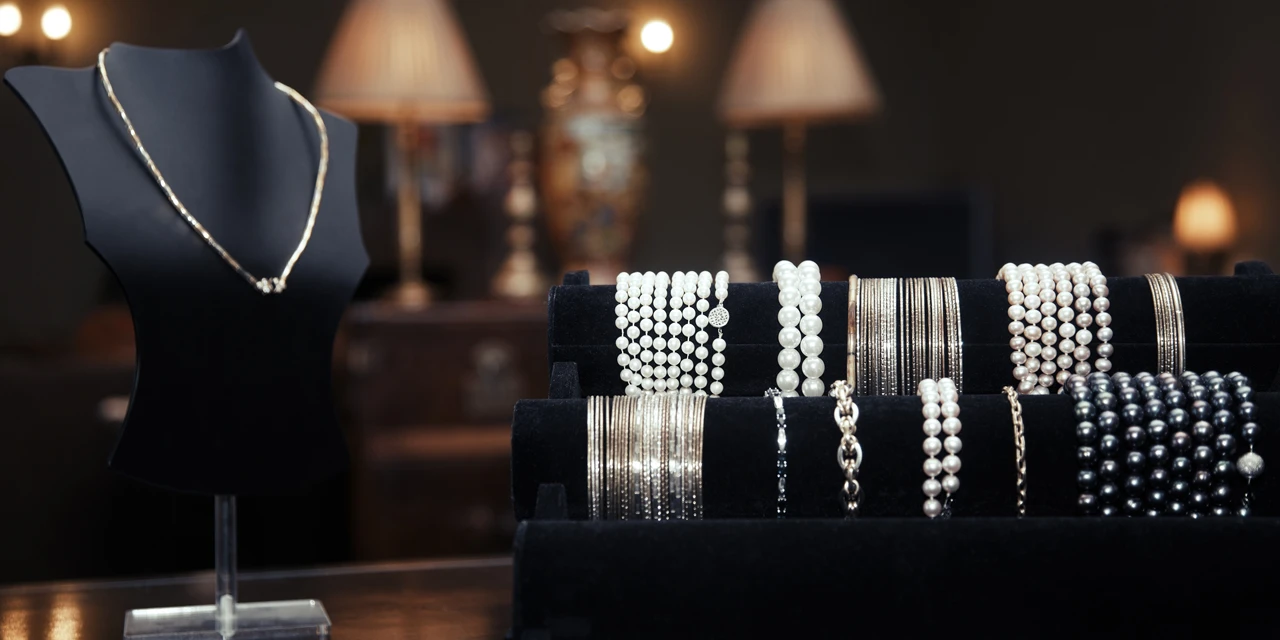
A jewelry store in Geneva needs no licence, federal or cantonal: a company entered in the commercial register, retail premises and stock are enough to open the doors. The rules that count apply to the pieces and to the way clients pay. Every article in gold, silver, platinum or palladium must carry two marks before it reaches the window, including pieces made in Vicenza, Paris or Dubai. Since 1 October 2026, a cash sale of unset diamonds or old gold calls for identification above CHF 15,000, against CHF 100,000 for a finished piece.
Contents
Scope of this guide
This page deals with jewelry stores, with or without a design or repair workshop. Trading in precious metals, refining, melting and the trade in rough diamonds are governed by separate and stricter regimes, which are not covered here. If your project is trading, read our guide to setting up a commodity trading company in Geneva.
A jewelry store in Geneva: no licence, but controlled pieces
Neither the Confederation nor the canton of Geneva makes the sale of jewelry subject to a licence, and no diploma is needed to register your company. The federal VET diploma for goldsmiths and jewellers (CFC) is useful if you run a design or repair workshop. It plays no part in the incorporation.
What the law controls is the article. The Precious Metals Control Act (PMCA) applies to every piece in gold, silver, platinum or palladium placed on the Swiss market. It also rules out selling on the move: “The hawking of articles subject to this Act is prohibited”, and the ban extends to orders taken by retail sales representatives (Art. 23 PMCA). Door-to-door sales of precious metal pieces and orders collected by travelling agents are therefore excluded.
Fineness and responsibility mark: two marks on every piece
The first mark states the fineness. The Act puts it plainly: “Precious metal articles may only be placed on the market with a legal fineness mark” (Art. 7(1) PMCA). Fineness is the purity of the precious metal in the alloy, measured in parts per thousand (Art. 3(1) PMCA), and every part of the piece must reach at least the standard it claims (Art. 7(2) PMCA). The legal standards themselves are set out in Annex 2 to the Act.
The second is the responsibility mark, a symbol that identifies its owner (Art. 9 and 10 PMCA). It must be submitted in writing to the Central Office for Precious Metals Control for registration (Art. 11(1) PMCA), and no fineness indication may be applied without it. A store that has its collection produced by outside workshops may use its own trademark as the responsibility mark (Art. 9(2) PMCA).
One provision matters to a founder who still lives abroad. An owner of a mark who is not listed in the Swiss commercial register or not resident in Switzerland may be asked to provide collateral (Art. 11(2) PMCA). Registering the mark in the name of your Geneva company, once it appears in the commercial register, keeps you outside that case.
| Question | What the PMCA says | Article |
|---|---|---|
| Must a gold ring go through official hallmarking? | No. For jewelry, official control is optional and requested by the owner; only precious metal watch-cases must be controlled | Art. 13 PMCA |
| Is an Italian or French hallmark enough? | No. The piece must meet Swiss law, including a responsibility mark registered in Switzerland | Art. 9, 11 and 20 PMCA |
| May a plated piece be labelled “gold”? | No. Any misleading mark on precious metal, plated or imitation articles is prohibited | Art. 6 PMCA |
| May the store sell door to door? | No. Hawking is prohibited | Art. 23 PMCA |
Source: Precious Metals Control Act (PMCA), SR 941.31, version in force since 1 July 2023.
Importing stock from Italy, France or Dubai
An article made abroad may be placed on the Swiss market only if it complies with the PMCA (Art. 20(1) PMCA). Imports can be tested in full or at random. Where testing reveals an offence, the piece is seized and sent to the Central Office, which files a criminal complaint; a piece that falls short of the rules without any offence is returned across the border (Art. 20(3) PMCA). Send your responsibility mark to each workshop together with the first order, because a piece delivered without it cannot go on display as it stands.
Customs duty, on the other hand, has disappeared. Since 1 January 2024, industrial products enter Switzerland duty-free, and that includes jewelry under chapter 71 of the tariff. Import VAT of 8.1% is still collected, and your company recovers it as input tax once it is registered for VAT.
Your jewelry store in Geneva
A company ready for suppliers, customs and the Central Office
Incorporation of the GmbH or AG and entry in the Geneva commercial register, a business address, a resident director while you still live abroad, stock and sales accounting, VAT and import declarations: RISTER® sets up and administers your company so that you can focus on your clients.
Request a meeting
RISTER – Corporate Service Provider in Geneva, reply within one business day.
Cash payments in Geneva: two thresholds since 1 October 2026
A store that accepts banknotes falls within the Anti-Money Laundering Act, which covers “natural persons and legal entities that deal in goods commercially and in doing so accept cash” (Art. 2(1)(b) AMLA). Above a threshold, such a dealer must verify the identity of the client, establish the beneficial owner and keep records (Art. 8a(1) AMLA). Instalments are added together, so splitting a payment changes nothing (Art. 8a(3) AMLA).
The general threshold is CHF 100,000. For transactions involving precious metals or precious stones, it falls to CHF 15,000 (Art. 8a(2bis) AMLA). The Anti-Money Laundering Ordinance, amended on 1 October 2026, lists what belongs in that second category (Art. 15a AMLO):
- More than CHF 100,000 in cash: finished jewelry such as set rings, necklaces and bracelets.
- More than CHF 15,000 in cash: melt products such as bars and ingots, melt material such as old gold, semi-finished products, and rubies, sapphires, emeralds and diamonds that are not strung, mounted or set.
RISTER advice
Since no licence exists, the risk for a Geneva jeweller lies elsewhere: in the loose stone sold by appointment and paid in banknotes. Before opening, prepare an identification form and a written procedure for your sales staff, and decide whether you accept cash above a given amount at all. Payment by card or bank transfer does not trigger these duties.
Taking in old gold from your clients
Accepting an old gold chain in part exchange, or buying gold to sell on to a refiner, means buying melt material (Art. 1(3) PMCA). Since 1 January 2023, anyone who does so commercially “must ascertain the origin of the goods and document this” (Art. 31a(1) PMCA). A company entered in the commercial register must in addition register with the Central Office (Art. 31a(2) PMCA); a person who is not entered needs a purchase licence instead (Art. 31a(3) PMCA).
The Federal Council defines in an ordinance what counts as commercial purchasing, so ask the Central Office before you advertise a buy-back service. The cash thresholds of the Anti-Money Laundering Act do not apply to these purchases, since the store pays the money rather than receiving it; they apply if it later sells old gold for cash.
Ivory, coral and tortoiseshell: protected materials
Pieces made of ivory, certain corals or tortoiseshell can fall under the federal act on trade in protected species of fauna and flora (CITES Act). Importing specimens of a listed species requires authorisation from the Federal Food Safety and Veterinary Office (FSVO) (Art. 7 CITES Act). A business that trades in them professionally keeps a register (Art. 11), and whoever sells such a piece hands the buyer the documents proving its lawful origin (Art. 10). Check the species of each piece, through the Species+ database or with the FSVO, before you take it into stock or on consignment.
Swiss made jewelry: reserved for pieces made here
An industrial product is Swiss when at least 60 per cent of its manufacturing costs are incurred in Switzerland and “an essential manufacturing step must have been carried out at this place” (Art. 48c(1) and (4) TmPA). A store that imports its collection and only sells it in Geneva cannot present those pieces as Swiss. A Geneva workshop that designs and makes its own jewelry can, provided it documents its costs. Our article on the Swiss made label explains the conditions and how they are checked.
Setting up the company behind your jewelry store in Geneva
The residence route depends on your nationality. EU and EFTA nationals receive a residence permit valid for at least five years if they show that they are settling in Geneva to work on a self-employed basis (Agreement on the Free Movement of Persons, Annex I, Art. 12). Nationals of other countries are admitted if the project serves the interests of the economy as a whole, meets the financial and operational requirements and provides them with an adequate, independent income (Art. 19 FNIA). Whatever your passport, the company must be represented by a person resident in Switzerland (Art. 718(4) and 814(3) CO).
For a single jewellery shop in Geneva, a GmbH with CHF 20,000 of fully paid-up capital is enough. An AG, with CHF 100,000 of capital of which at least CHF 50,000 is paid up, gives suppliers and insurers more comfort once the stock reaches several hundred thousand francs. VAT registration is mandatory from CHF 100,000 of annual turnover (Art. 10(2)(a) VAT Act). Our company incorporation service in Geneva takes you through each step, from the articles of association to the commercial register.
A worked case: a Dubai jeweller opens in Geneva
A jeweller based in Dubai opens a boutique on the left bank through a Geneva AG, with a director resident in Switzerland. The AG registers its own responsibility mark with the Central Office; as the company is entered in the commercial register, the collateral question does not arise in principle. The Dubai workshop strikes that mark and the fineness on every piece before shipping, and each consignment clears customs free of duty, with 8.1% import VAT.
In the first month, a client offers CHF 22,000 in banknotes for two unset diamonds. The sale falls under the CHF 15,000 threshold, so the boutique verifies the client’s identity, establishes the beneficial owner and keeps copies before accepting. A week later, another client pays CHF 60,000 in cash for a finished diamond necklace: below CHF 100,000, Art. 8a AMLA imposes no identification. None of the pieces made in Dubai carries a Swiss made claim.
FAQ: jewelry store in Geneva
Do you need a licence to open a jewelry store in Geneva?
No. Neither the Confederation nor the canton of Geneva requires a licence or a diploma to sell jewelry. The duties concern the pieces: every article in gold, silver, platinum or palladium must carry a fineness indication and a responsibility mark registered with the Central Office (Art. 7, 9 and 11 PMCA).
Which marks must a gold piece carry?
A legal fineness mark, measured in parts per thousand, and a responsibility mark registered with the Central Office for Precious Metals Control. Official hallmarking by an assay office is optional for jewelry and mandatory only for precious metal watch-cases (Art. 13 PMCA).
What if a client pays cash?
Above CHF 100,000 in cash for finished jewelry, or above CHF 15,000 for unset rubies, sapphires, emeralds and diamonds, bars, old gold or semi-finished products, the store verifies the client’s identity, establishes the beneficial owner and keeps records (Art. 8a AMLA, Art. 15a AMLO). Payments made in instalments are added together.
Can a Geneva jewelry store buy old gold?
Yes. A store that buys old gold commercially must ascertain and document its origin and, as a company entered in the commercial register, register with the Central Office (Art. 31a PMCA). The cash thresholds of the Anti-Money Laundering Act concern what the store receives, not what it pays out.
Can you sell ivory or coral jewelry?
Only with documents proving lawful origin. Importing specimens of protected species requires FSVO authorisation, professional traders keep a register, and the seller passes the documents to the buyer (Art. 7, 10 and 11 CITES Act).
Can imported jewelry be sold as Swiss made?
No. Swiss origin requires at least 60 per cent of manufacturing costs in Switzerland and an essential manufacturing step carried out there (Art. 48c TmPA). A piece that is imported and only sold in Geneva meets neither condition.
Sources
- Precious Metals Control Act (PMCA), SR 941.31
- Anti-Money Laundering Act (AMLA), SR 955.0
- Anti-Money Laundering Ordinance (AMLO), SR 955.01 (French)
- Federal act on trade in protected species of fauna and flora (CITES Act), SR 453 (French)
- Trade Mark Protection Act (TmPA), SR 232.11
- Foreign Nationals and Integration Act (FNIA), SR 142.20
- Code of Obligations (CO), SR 220, Art. 718 and 814 (French)
- Value Added Tax Act, SR 641.20
Conclusion
A jewelry store in Geneva opens without a licence and then runs on discipline: a responsibility mark registered before the first order, imported pieces that meet Swiss law, two cash thresholds that every salesperson knows, documented origin for old gold, papers for protected materials, and a Swiss made claim kept for what is made here. Stores that settle these points before opening day rarely meet surprises at customs or at the counter. RISTER supports Geneva jewelry stores with incorporation, then with bookkeeping, VAT and imports, under the direction of Andrés Taracido and his more than 25 years of experience in corporate services.