
Since 1 October 2026, the Swiss Anti-Money Laundering Act (AMLA) has applied to domiciliation. Anyone who, on a professional basis, provides a legal entity with an address or premises as its domicile or registered office for more than six months is deemed an “adviser” (Art. 2 para. 3ter AMLA). The provider must identify the client and the beneficial owner, keep records, train its staff, report suspicions to the Money Laundering Reporting Office Switzerland (MROS) and join a self-regulatory organisation (SRO). Domicile providers already operating on 1 October have until 1 December 2026 to act.
This guide sets out the framework from the provider’s side and ends with an AMLA domiciliation checklist to work through before the deadline.
Contents
- AMLA domiciliation: what changes on 1 October 2026
- When a domicile provider becomes an adviser under the Swiss AMLA
- The AMLA obligations of a domicile provider
- SRO affiliation: the 1 December 2026 deadline
- Corporate Service Providers already affiliated with an SRO
- What the AMLA changes for the domiciled company
- AMLA domiciliation checklist before 1 December 2026
- Case study: a Geneva business centre and its 40 domiciled companies
AMLA domiciliation: what changes on 1 October 2026
Until 30 September 2026, providing a registered address did not bring a provider within the AMLA, as long as it neither managed its clients’ funds nor sat on their governing bodies. The Act knew only financial intermediaries and traders. It now has a third category, advisers (Art. 2 para. 1 let. c AMLA), and domiciliation is named in it.
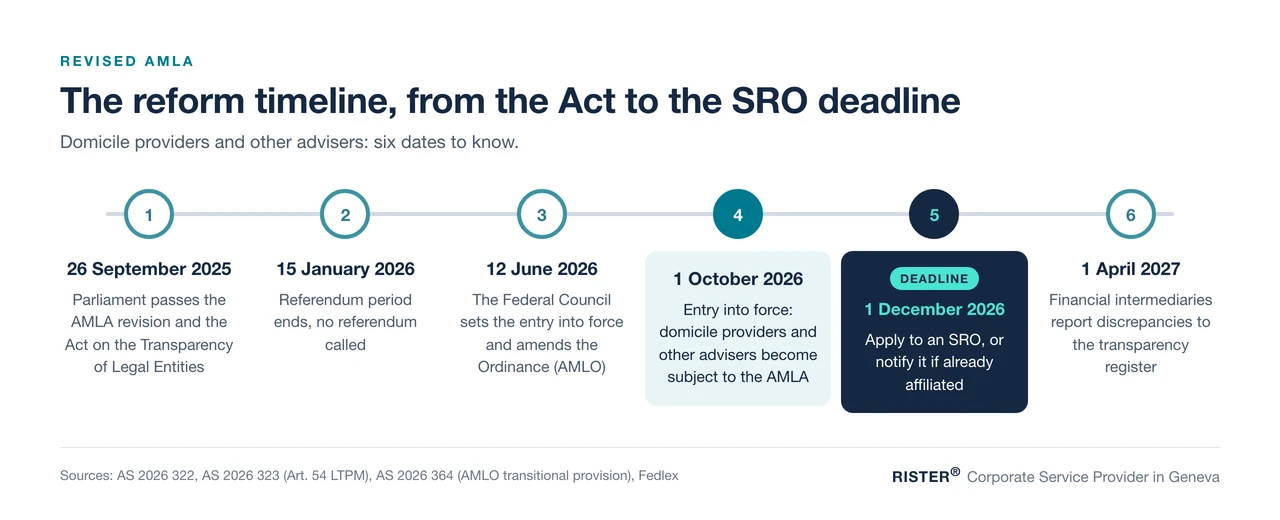
The change comes from the amendment to the AMLA of 26 September 2025, published in the Official Compilation of Federal Legislation as AS 2026 322. Parliament passed it on the same day as the Federal Act on the Transparency of Legal Entities (LTPM). No referendum had been requested when the deadline expired on 15 January 2026, and the Federal Council set the entry into force for 1 October 2026.
The provision that targets domiciliation fits in one sentence. Under Art. 2 para. 3ter AMLA, “legal entities and natural persons who, on a professional basis, make an address or premises available to a legal entity as its domicile or registered office for a period exceeding six months are also deemed to be advisers” (unofficial translation; the binding versions are German, French and Italian).
| Point | Until 30 September 2026 | Since 1 October 2026 |
|---|---|---|
| Status of the domicile provider | Outside the AMLA for domiciliation alone | Adviser (Art. 2 para. 3ter AMLA) |
| Due diligence | None in respect of domiciliation | Art. 8b to 8d AMLA |
| Reporting to MROS | None in respect of domiciliation | Art. 9 para. 1ter AMLA |
| Supervision | None | Affiliation with an SRO (Art. 14 para. 1 AMLA) |
| Public disclosure | None | Public register kept by FINMA (Art. 18b AMLA) |
Source: AMLA (SR 955.0), version in force since 1 October 2026, Fedlex.
The general regime for financial intermediaries, with its internal organisation, AML officer and SRO audits, is a subject in its own right. Here, RISTER® deals with domiciliation only.
When a domicile provider becomes an adviser under the Swiss AMLA
A domicile provider becomes an adviser when four conditions are met together: it acts on a professional basis, it provides an address or premises, the entity uses them as its domicile or registered office, and the arrangement lasts more than six months. If any one condition is missing, Art. 2 para. 3ter does not apply.
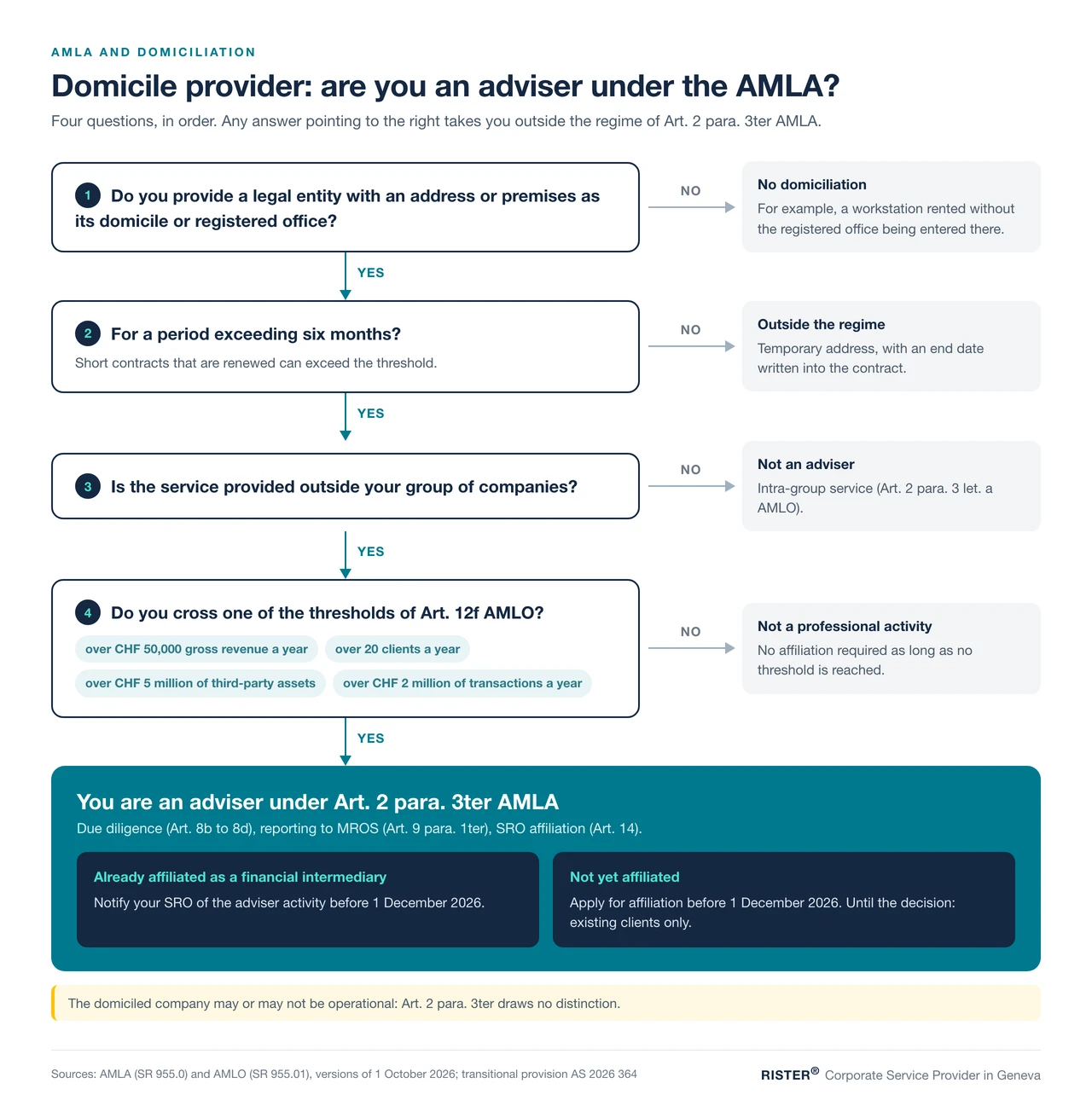
AMLA advisers: the four conditions of Art. 2 para. 3ter
- On a professional basis: assessed under the Anti-Money Laundering Ordinance (AMLO); see the table below.
- An address or premises: a simple c/o address is enough, no office is required.
- As domicile or registered office: what counts is the entity’s use of the address as its registered office or domicile, not the rental of a space as such.
- For a legal entity, for more than six months: a company, foundation, association or comparable structure.
The thresholds for professional activity
Advice is provided on a professional basis when it amounts to an independent economic activity aimed at a lasting income (Art. 12f para. 1 AMLO). The Ordinance also sets four thresholds, any one of which is enough. Domiciliation may be the main business or an ancillary service: the classification is the same (Art. 12f para. 2 AMLO).
| Threshold (per calendar year) | Basis | What it means for a domicile provider |
|---|---|---|
| Gross revenue above CHF 50,000 | Art. 12f para. 1 let. a AMLO | 34 contracts invoiced at CHF 1,500 a year |
| More than 20 clients or more than 20 legal transactions | Art. 12f para. 1 let. b AMLO | 21 domiciled companies, whatever the price |
| Third-party assets above CHF 5 million | Art. 12f para. 1 let. c AMLO | Rarely reached through domiciliation alone |
| Financial transactions above CHF 2 million | Art. 12f para. 1 let. d AMLO | Likewise |
Source: AMLO (SR 955.01), Art. 12f, version in force since 1 October 2026.
The twenty-client threshold is the one that catches people out. A business centre that domiciles twenty-one companies falls within the Act, even at modest prices.
Six months of actual use
An address lent for less than six months, while a registered office is being transferred or during a move, stays outside the regime. The text does not say how short contracts renewed one after another are to be counted.
RISTER advice
Three months renewed twice make nine months of registered office. Treat any domiciliation meant to last as subject to the AMLA from the day it is signed, and keep the “less than six months” regime for genuinely temporary addresses, with an end date written into the contract.
Operational or not, the domiciled company is covered
The neighbouring paragraph, para. 3bis, targets only non-operational legal entities. Para. 3ter does not repeat that restriction. Domiciling an active Geneva SME, with its own employees and customers, makes the provider an adviser just as surely as domiciling an asset-holding company.
Domiciled company or domiciliary company: two different things
A domiciled company uses a provider’s address as its registered office. A domiciliary company is a legal category: a structure that carries on no trading, manufacturing or other commercially run business (Art. 6 para. 2 AMLO), such as a holding company that does nothing but hold a family’s assets. Not every domiciled company is a domiciliary company, and Art. 2 para. 3ter applies to both. The definition, its indicators and what it means for directors are explained in our article on domiciliary companies and the AMLA duties of their officers.
Out of scope, and the grey areas
- Within a group: services between companies of the same group do not make the provider an adviser (Art. 2 para. 3 let. a AMLO). A parent company that hosts its subsidiaries’ registered offices is not covered.
- Occasional activity: below the four thresholds of Art. 12f AMLO, there is no professional activity.
- Business centres and coworking spaces: in our reading, a workstation rented without the registered office being entered at that address does not fall under para. 3ter. As soon as an entity enters its registered office at that address in the commercial register for more than six months, the operator comes within the regime. No official source has settled the point yet: your SRO has the final word.
The AMLA obligations of a domicile provider
A domicile provider acting as an adviser must identify, understand, document, organise itself and report. These obligations are lighter than those of a financial intermediary, but they apply to every contract, including those signed before 1 October 2026.
The client and the beneficial owner
Art. 8b para. 1 AMLA refers to three rules of the general regime. The provider verifies the client’s identity against a document and, where the client is a legal entity, takes note of the powers to bind the company and verifies the identity of those who sign on its behalf (Art. 3 para. 1 AMLA). It identifies the beneficial owner and obtains a written declaration, required in particular where the client is a domiciliary company or an operating legal entity (Art. 4 para. 1 and para. 2 let. a and b AMLA).
The purpose of the domiciliation
The provider must also establish the nature and purpose of the service (Art. 8b para. 2 AMLA): why a registered office in Geneva, for what business, with which managers. Where the risk is high, it clarifies the background (Art. 8b para. 3 AMLA). The cases that call for this are set out in its SRO’s regulations (Art. 8c para. 2 AMLA).
Records, kept for ten years
Checks are recorded in a way that allows a qualified third party to form an objective view of the file, reviewed periodically according to risk and kept for ten years after the relationship ends (Art. 7 para. 1, 1bis and 3 AMLA). A pile of passport copies does not meet that standard. You must be able to show what was understood about the client, and when.
Internal organisation
Art. 8d AMLA requires the organisational measures needed to prevent money laundering, terrorist financing and breaches of coercive measures based on the Embargo Act (EmbA), with adequate staff training and controls. In a small business, that means at the very least a written directive, documented training and an annual review of files.
Reporting to MROS
The provider informs MROS immediately if it knows or has reasonable grounds to suspect that the assets connected with the service are of criminal origin or derive from a qualified tax offence, or if it turns a client away for that reason (Art. 9 para. 1ter AMLA). It must not tell the client or any third party (Art. 10a para. 5 AMLA). Once the report has been made, it may end the relationship at any time (Art. 9b para. 2bis AMLA).
Important
Wilfully breaching the duty to report is punishable by a fine of up to CHF 500,000; through negligence, by a fine of up to CHF 150,000 (Art. 37 AMLA).
What the law does not require of a domicile provider
An adviser is not a financial intermediary. Art. 8b provides for neither a systematic check on the source of funds nor ongoing transaction monitoring: it asks the provider to understand the service and to look further when the risk calls for it.
| Obligation | Domicile provider (adviser) | Financial intermediary |
|---|---|---|
| Client identity | Art. 8b para. 1 let. a | Art. 3 |
| Beneficial owner | Art. 8b para. 1 let. b | Art. 4 |
| Nature and purpose | Of the service (Art. 8b para. 2) | Of the business relationship (Art. 6 para. 1) |
| Enhanced clarifications | If the risk is high (Art. 8b para. 3) | Unusual transaction, indications, higher risk (Art. 6 para. 2) |
| Records | Ten years (Art. 7) | Ten years (Art. 7) |
| Organisation | Art. 8d | Art. 8 |
| Reporting to MROS | Art. 9 para. 1ter | Art. 9 para. 1 |
Source: AMLA (SR 955.0), Art. 3 to 9 and 8b to 8d, version of 1 October 2026.
SRO affiliation: the 1 December 2026 deadline
Every adviser must join a self-regulatory organisation (Art. 14 para. 1 AMLA). A domicile provider already active on 1 October 2026 must file its application before 1 December 2026 and, until a decision is made, may no longer take on new clients.
Conditions for affiliation
The SRO checks that the applicant has appropriate internal rules and organisation, that it enjoys a good reputation, that its directors and managers offer the same guarantees and that holders of qualifying participations are of good standing (Art. 14 para. 2 AMLA). Each SRO may set additional conditions (Art. 14 para. 3 AMLA). ARIF and SO-FIT, among others, have already published guidance for advisers.
The timetable set by the Ordinance
The AMLO’s transitional provision leaves no room for manoeuvre. Anyone acting as an adviser on 1 October 2026 must apply for affiliation before 1 December 2026; until the decision, they may continue only within existing business relationships.
Important
While the application is being processed, a domicile provider that was not already a financial intermediary cannot sign any new domiciliation contract. Every week of delay in filing adds a week to the period without new clients.
A provider that starts the activity after 1 October 2026, or crosses a threshold during the year, applies the due diligence obligations from the moment its status changes and has two months to apply for affiliation (Art. 12g para. 1 AMLO). If it does not apply within that period, or if its application is rejected, it is prohibited from acting as an adviser (Art. 12g para. 3 AMLO).
FINMA’s public register
FINMA keeps a public register, available online, of advisers affiliated with an SRO (Art. 18b AMLA). It is the simplest check a client can carry out before entrusting its registered office to anyone.
Penalties
Wilfully carrying on an activity that requires SRO affiliation without being affiliated is punishable by a custodial sentence of up to three years or a monetary penalty; through negligence, by a fine of up to CHF 250,000 (Art. 44 of the Financial Market Supervision Act, FINMASA). After 1 December 2026, a domicile provider that has filed nothing is therefore operating without the affiliation the law requires.
Corporate Service Providers already affiliated with an SRO
A Corporate Service Provider already affiliated with an SRO as a financial intermediary does not need to apply again: the organisation that supervises its financial activities also supervises its activity as an adviser (Art. 12a para. 2 AMLA). It must, however, notify its SRO of that activity before 1 December 2026.
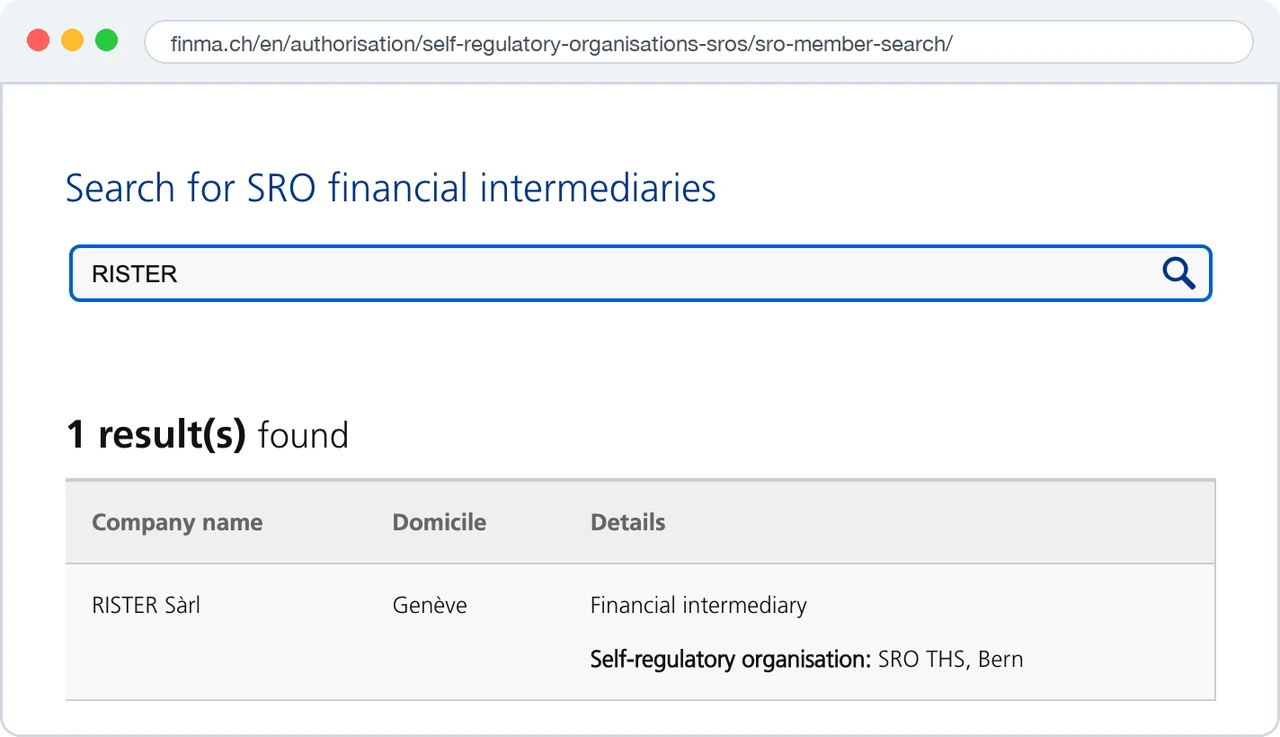
This is the position of RISTER, which domiciles companies in Geneva: RISTER Sàrl appears in FINMA’s SRO member search as a financial intermediary affiliated with OAR FIDUCIAIRE|SUISSE. For a provider of this kind, the revision does not change the architecture of compliance, it extends it: domiciliation comes within the scope of the procedures, controls and audits already in place.
Two coordination rules complete the picture. Where the same activity falls under both financial intermediation and advice, the rules for financial intermediaries apply (Art. 2b para. 1 AMLA). A Corporate Service Provider may also declare that it subjects all its activities to those rules (Art. 2b para. 2 AMLA); the declaration takes effect on 1 January of the calendar year following its submission (Art. 2a para. 3 AMLO). During the transitional period, it may continue to serve its existing clients and accept new mandates from them (AMLO transitional provision).
What the AMLA changes for the domiciled company
The domiciled company is not itself subject to the Act: its domicile provider is. For the company, the revision means a fuller onboarding file, regular updates and a new criterion when choosing a provider.
Documents requested at signature
- An extract from the commercial register or, for a company being formed, the articles of association and the deed of incorporation.
- The identity document of the persons signing the contract and proof of their power to bind the company.
- The written declaration naming the beneficial owner.
- A description of the business and of the reason for having a registered office in Geneva.
This information will be requested again periodically, and more often if the profile is considered higher risk (Art. 7 para. 1bis AMLA). A provider that asks for nothing is not being more accommodating: it exposes the company to termination on the day its SRO inspects its files.
The transparency register
The Federal Act on the Transparency of Legal Entities, which came into force on the same day, allows domicile providers to consult the transparency register online for their checks (Art. 27 LTPM). If their review reveals nothing unusual, they may rely on the entries in the register (Art. 23 para. 2 LTPM). Reporting discrepancies to the register is reserved for financial intermediaries (Art. 30 LTPM). The notification deadlines that apply to companies are covered by our parent company in its guide to the Swiss transparency register.
Choosing a compliant domicile provider
Before signing, check that the provider is listed in FINMA’s SRO member search or, until its SRO has decided, ask for proof that it has filed its application; then read the AMLA clause in the contract. Under the Swiss Code of Obligations (CO), the company must also be capable of being represented by a person resident in Switzerland: Art. 718 para. 4 CO for a company limited by shares (AG/SA), Art. 814 para. 3 CO for a limited liability company (GmbH/Sàrl). Domiciliation alone does not satisfy that requirement. Our company domiciliation service in Geneva builds these checks in from the moment the file is opened, and our guide to choosing the canton in which to domicile your company compares the other options.
AMLA domiciliation checklist before 1 December 2026
For a domicile provider active on 1 October 2026, compliance comes down to eight steps.
- Measure the activity: companies domiciled for more than six months, gross revenue for the year, intra-group services to be left out.
- Establish your status: already affiliated as a financial intermediary (notification) or not (application for affiliation).
- Choose the SRO and read its regulations: they set the extent of due diligence (Art. 8c para. 2 AMLA).
- Write the internal directive: identification, beneficial owner, high-risk criteria, reporting to MROS, record-keeping.
- Appoint a person in charge and train your staff, with certificates to prove it (Art. 8d AMLA).
- Review every existing file: identity, powers, beneficial owner declaration, purpose of the service.
- Update the standard contract: AMLA clause, duty to report changes, right of termination.
- File the application or notification before 1 December 2026 and keep proof of it.
Domiciliation in Geneva
A registered office with a Corporate Service Provider affiliated with an SRO
Looking for a registered office in Geneva? We domicile your company, as a financial intermediary affiliated with OAR FIDUCIAIRE|SUISSE, with a complete AMLA file from signature and the same contact person for your accounting, VAT and tax.
Request a meeting
RISTER – Corporate Service Provider in Geneva, reply within one business day.
Case study: a Geneva business centre and its 40 domiciled companies
A business centre in Geneva’s Plainpalais district rents out offices and, alongside them, domiciles 40 companies, each invoiced CHF 1,500 a year. It never handles its clients’ funds and has never been affiliated with an SRO.
Its gross revenue from domiciliation comes to CHF 60,000: the CHF 50,000 threshold of Art. 12f para. 1 let. a AMLO is exceeded, and so is the twenty-client threshold (let. b). Since 1 October 2026, it has been a professional adviser for all 40 contracts, whether it domiciles holding companies or trading SMEs.
If it files its application on 20 November and the SRO decides in February, it will be unable to sign any new domiciliation contract for almost three months, while continuing to serve its 40 companies. Office tenants who have not registered their office at its address remain outside para. 3ter.
The calculation would be the same in Lausanne, Zurich or Lugano: the AMLA is federal law. The only difference is the commercial register office where the companies enter their registered office.
FAQ: AMLA and domiciliation
Is a domicile provider subject to the AMLA?
Yes, since 1 October 2026. Anyone who, on a professional basis, provides a legal entity with an address or premises as its domicile or registered office for more than six months is deemed an adviser (Art. 2 para. 3ter AMLA). The provider applies the due diligence obligations of Art. 8b to 8d, reports suspicions to MROS and must be affiliated with a self-regulatory organisation.
Who are advisers under the AMLA?
First, persons who, on a professional basis and on behalf of third parties, take part in financial transactions connected with the sale of real estate, the formation of Swiss non-operational entities or of foreign entities, or the management, contributions, distributions and sale of non-operational entities (Art. 2 para. 3bis AMLA). Second, domicile providers that supply a registered office for more than six months (Art. 2 para. 3ter). Board mandates are covered in our article on the AMLA obligations of directors and managing officers of a domiciliary company.
Is a domiciliation of less than six months covered?
No: Art. 2 para. 3ter refers to a period exceeding six months, and an address provided for three months during a transfer of registered office stays outside the regime. The law says nothing about renewed short contracts. As a precaution, any domiciliation intended to last should be treated as covered from the day it is signed.
What is the deadline for joining an SRO?
A domicile provider active on 1 October 2026 must apply for affiliation before 1 December 2026 (AMLO transitional provision). Until the decision, it may act only within existing business relationships. A Corporate Service Provider already affiliated as a financial intermediary simply notifies its adviser activity by the same date; a newcomer has two months (Art. 12g AMLO).
Does a domicile provider have to check the source of funds?
Not systematically. Art. 8b AMLA requires it to verify the client’s identity, identify the beneficial owner, keep records and understand the purpose of the service. It clarifies the background only where the risk is high, according to its SRO’s criteria. Establishing the source of funds belongs mainly to the financial intermediary regime (Art. 6 AMLA).
Are business centres and coworking spaces covered?
Yes, if they allow entities to enter their registered office at their address for more than six months and exceed one of the thresholds of Art. 12f AMLO, for example twenty clients or CHF 50,000 of gross revenue a year. Renting out a workstation without the registered office being entered there does not, on a reading of the text, amount to domiciliation within the meaning of para. 3ter.
How can you check that a domicile provider is compliant?
Consult the public register of advisers affiliated with an SRO, kept by FINMA (Art. 18b AMLA). Until 1 December 2026, and while applications are being processed, a provider may not yet appear in it: ask for proof that it has filed its application or, if it is already a financial intermediary, that it has notified its SRO.
Sources
- Anti-Money Laundering Act (AMLA, SR 955.0), version in force since 1 October 2026: Art. 2, 2b, 3, 4, 7, 8b to 8d, 9, 9b, 10a, 12a, 14, 18b, 37 (official French version)
- Amendment of the AMLA of 26 September 2025 (AS 2026 322, official French version)
- Anti-Money Laundering Ordinance (AMLO, SR 955.01): Art. 2, 2a, 12f, 12g and transitional provision of the amendment of 26 September 2025 (official French version)
- Ordinance of 12 June 2026 on the Transparency of Legal Entities, Annex No. 6: amendment of the AMLO and transitional provision (AS 2026 364, official French version)
- Federal Act on the Transparency of Legal Entities (LTPM, SR 955.3): Art. 23, 27 and 30 (official French version)
- Financial Market Supervision Act (FINMASA, SR 956.1): Art. 44 (official French version)
- FINMA: combating money laundering
- FINMA: SRO member search (consulted on 7 October 2026)
- ARIF: AML Advisors FAQ (in English)
- SO-FIT: communication on the new AMLA and adviser activities (September 2026, in French)
Conclusion
The revised AMLA makes every professional domicile provider a link in the fight against money laundering, on a tight timetable: an application for affiliation before 1 December 2026 and no new clients until the SRO has decided or, for a Corporate Service Provider that is already affiliated, a notification to its SRO by the same date. For a company, the address of its registered office now also depends on the compliance of whoever provides it.
RISTER, a Geneva Corporate Service Provider affiliated with OAR FIDUCIAIRE|SUISSE, domiciles and administers companies in Geneva under a management team with 25 years of experience. To review the compliance of your domiciliation or to transfer your registered office, contact our experts.