
Unlike many European countries, Switzerland does not have a national minimum wage. The Swiss labor market operates through a decentralized system in which minimum pay levels may be set either by individual cantons or through collective agreements negotiated between social partners.
In practice, the legally required minimum wage may be determined through several mechanisms:
- cantonal minimum wage laws;
- Collective Labor Agreements (CLAs);
- Standard Employment Contracts (SECs).
These legal instruments establish mandatory baseline remuneration for employees, workers, and other professionals across various economic sectors.
Over the past few years, several Swiss cantons have introduced their own minimum wage thresholds. The most prominent example is Geneva, which currently applies the highest hourly minimum wage in the world. In this canton, the minimum wage reaches 24.59 CHF per hour in 2026, equivalent to more than 4,400 CHF in gross monthly salary for a full-time position.
Geneva is not an isolated case. Other cantons such as Neuchâtel, Jura, Ticino, and Basel-City have also introduced mandatory minimum income levels in order to protect the local workforce from wage dumping and unfair salary competition.
In this comprehensive guide, we analyze in detail the minimum wage in Switzerland in 2026: cantonal rates, legal rules applicable to employers and businesses, calculation of gross and net wages, and comparisons with other European countries such as France and Germany.
📑 Table of Contents
Why is there no national minimum wage in Switzerland?
The rejection of the 2014 federal initiative
Switzerland has long debated the introduction of a nationwide wage floor. In 2014, a popular initiative proposed establishing a federal minimum wage of 22 Swiss francs per hour.
However, Swiss voters rejected the proposal: 76% of voters opposed introducing a uniform minimum wage across the country.

Several arguments were put forward:
- the strong economic diversity between cantons;
- significant differences in cost of living between regions;
- the tradition of cantonal autonomy;
- the central role of collective labor agreements.
Voters therefore concluded that a single nationwide wage floor did not fit the Swiss economic structure or the functioning of its labor market.
The Swiss model: CLAs and SECs as wage protection mechanisms
Rather than imposing a national minimum wage, Switzerland relies on specific contractual and legal instruments.
Collective Labor Agreements (CLAs)
CLAs are agreements negotiated between employers and trade unions within a specific industry. They define, among other things:
- minimum salary levels for each profession;
- working conditions;
- working hours;
- vacation entitlements;
- bonuses;
- allowances and compensation.
Some CLAs are declared generally binding by the federal authorities. In such cases, they apply to all companies within the relevant sector, even if those companies were not part of the original negotiations.
This is notably the case in sectors such as:
- construction;
- metalworking;
- hospitality and catering;
- certain industrial sectors.
Standard Employment Contracts (SECs)
Cantons may also introduce these standard contracts in order to combat wage dumping.
These SECs set mandatory minimum wages in sectors where no collective agreement exists. They therefore function as a social safety net aimed at protecting employees, particularly in vulnerable sectors.
Minimum wage by canton in 2026
In 2026, only a few Swiss cantons have introduced a statutory minimum wage applicable to all workers. Unlike many European countries, Switzerland therefore does not have a national minimum wage. Wage floors are determined either by cantonal legislation or by social partners through collective agreements.
Table of cantons applying a legal minimum wage
| Canton | Hourly rate (CHF) | Estimated hourly rate (EUR) |
|---|---|---|
| Geneva | 24.59 CHF | ≈ €25.80 |
| Neuchâtel | 21.31 CHF | ≈ €22.40 |
| Jura | 21.40 CHF | ≈ €22.50 |
| Ticino | approx. 19.50 CHF | ≈ €20.40 |
| Basel-City | approx. 21.00 CHF | ≈ €22.00 |
Cantonal minimum wages in Switzerland in 2026.
These figures correspond to minimum gross remuneration levels and are regularly adjusted to account for inflation, changes in the cost of living, and economic conditions specific to each canton.
The Geneva minimum wage: the highest in the world
Geneva is currently the most well-known example of a cantonal minimum wage system. Introduced in 2020 following a popular vote, the measure primarily aims to:
- combat wage dumping;
- protect the local workforce;
- guarantee a decent minimum income for employees.
This policy responds to a specific economic reality: Geneva sits at the center of a cross-border region where competition in the labor market is particularly strong, notably due to the large number of cross-border workers and the international openness of the local economy.
The Geneva wage floor therefore functions as a regulatory tool for the labor market and as a mechanism to protect purchasing power.
Legal rate in 2026
In 2026, the statutory minimum hourly wage is:
24.59 CHF per hour.
This rate applies to the majority of employees working in the canton, except for certain legal exceptions.
Monthly salary calculation
In Switzerland, the average working time generally ranges between 40 and 42 hours per week.
Based on a 40-hour workweek:
40 hours × 4.33 weeks = 173 hours per month
173 × 24.59 CHF = ≈ 4,250 CHF gross monthly salary
Based on a 42-hour workweek:
42 hours × 4.33 = 182 hours
182 × 24.59 CHF = ≈ 4,470 CHF gross monthly salary
This salary may then be supplemented, depending on the situation, by:
- a 13th salary payment;
- vacation allowances;
- bonuses or performance incentives provided by the employer or a CLA.
Neuchâtel, Jura, Ticino and Basel-City
Several other Swiss cantons have introduced a statutory minimum wage in recent years.
Neuchâtel
Neuchâtel was the first Swiss canton to introduce a cantonal minimum wage.
In 2026, the minimum wage amounts to approximately:
21.31 CHF per hour.
The system aims to guarantee a minimum income in sectors not covered by collective agreements.
Jura
The canton of Jura also applies a minimum wage.
The remuneration is approximately:
21.40 CHF per hour.
The objective is similar: preventing wage dumping in poorly regulated sectors.
Ticino
Ticino introduced a minimum wage gradually between 2021 and 2024.
The wage may vary depending on sectors but generally ranges around:
19 to 20 CHF per hour.
This level remains lower than Geneva due to a generally lower cost of living.
Basel-City
In 2025, Basel-City adopted a statutory minimum wage.
The remuneration is around:
21 CHF per hour.
This measure aims primarily to protect workers in low-wage sectors.
The 21 cantons without a statutory minimum wage
The majority of Swiss cantons have not introduced a legal minimum wage.
This includes cantons such as:
- Zurich;
- Vaud;
- Bern;
- Fribourg;
- Valais;
- St. Gallen.
In these regions, minimum wages are mainly determined through:
- collective labor agreements;
- standard employment contracts;
- market practices.
This system is generally considered more flexible and better suited to local economic realities.
How to Calculate the Minimum Wage in Switzerland (Gross vs Net)
Calculating the Monthly Gross Salary
The calculation method is straightforward:
hourly rate × number of hours = gross income.
In Switzerland, the average working time generally ranges between 40 and 42 hours per week depending on the industry, sector, and collective labor agreements. Based on this, the average number of working hours per month is approximately 182 hours.

Example:
24 CHF × 182 hours = 4,368 CHF gross monthly salary.
This amount represents the gross monthly salary before any social security or tax deductions.
Social Security Deductions
The gross salary does not correspond to the net salary received by the employee. In Switzerland, several mandatory social security contributions are deducted directly from the salary slip to finance the national social insurance system.
The main deductions include:
- AHV/AVS – Old-age and survivors’ insurance;
- IV/AI – Disability insurance;
- EO/APG – Loss of earnings compensation;
- ALV/AC – Unemployment insurance;
- LPP/BVG – Occupational pension scheme.
In total, these mandatory employee contributions generally represent around 12% to 15% of the gross salary, depending on the employee’s age, the pension fund, and the specific conditions of the employer. To ensure the accuracy of these complex calculations, many companies outsource their payroll management in Switzerland to a specialized fiduciary, ensuring compliance with cantonal rates and withholding tax scales.
It is also important to consider mandatory health insurance. Unlike in many European countries, this insurance is not deducted directly from the salary by the employer. Instead, each resident must subscribe individually and pay the premium directly to their insurer.
These elements appear on the employee’s payslip and are also reported in the annual salary certificate known as the Lohnausweis.
The Case of the 13th Salary
In Switzerland, many companies provide a 13th salary. This represents an additional month of salary, usually paid at the end of the year, most commonly in December.
The 13th salary is not a federal legal obligation. However, it is extremely common in practice and represents a standard benefit in many industries. In certain sectors, its payment is explicitly required by collective labor agreements.
In cantons where a statutory minimum wage exists, authorities often specify that the official hourly rate already takes the 13th salary into account. In other words, the displayed minimum wage generally corresponds to an annual remuneration distributed over twelve months while including the equivalent value of a 13th salary.
Comparison: Swiss Minimum Wage vs Other European Countries
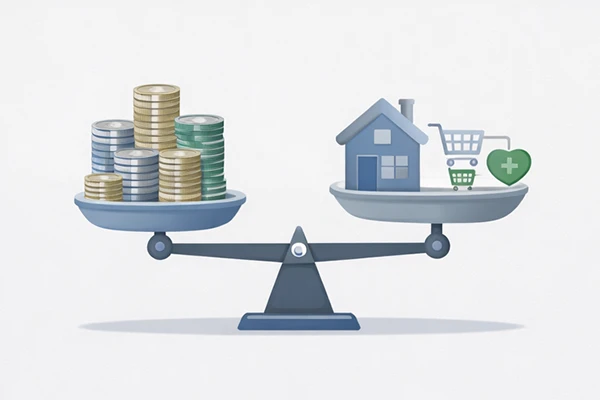
The Swiss minimum wage is often presented as the highest in the world, particularly in the canton of Geneva. However, direct comparisons with other European countries should be interpreted carefully because they do not always account for differences in the cost of living.
Comparison of Approximate Monthly Minimum Wages
| Country | Approximate Monthly Minimum Wage |
|---|---|
| Switzerland (Geneva) | approx. 4,400 CHF |
| France | approx. €1,770 |
| Germany | approx. €2,100 |
| Spain | approx. €1,260 |
Comparison of minimum wages in Switzerland and other European countries (2026).
At first glance, the gap between Switzerland and other European countries appears very large. The Geneva minimum wage is significantly higher than those observed in France, Germany, or Spain.
However, this comparison must be considered alongside the overall cost of living in Switzerland, which is among the highest in the world.
The Cost of Living in Switzerland
Switzerland consistently ranks among the most expensive countries in Europe and worldwide. Household expenses are particularly high, especially in large cities such as Geneva, Zurich, or Basel.

Major expenses typically include:
- housing;
- health insurance;
- transportation;
- food and everyday consumer goods.
Examples:
- mandatory health insurance: approximately 350 to 600 CHF per month for an adult;
- apartment rent in Geneva: typically between 1,500 and 2,500 CHF per month, sometimes more depending on location and size.
These significant fixed costs mechanically reduce the apparent advantage of a high minimum wage. In practice, the real purchasing power of Swiss workers remains relatively comparable to that of workers in several European countries with lower living costs.
Employers and Workers: Rights and Obligations
For Employers
Companies operating in Switzerland must comply with the wage rules applicable in their canton and industry sector. This notably includes compliance with:
- cantonal minimum wages where they exist;
- minimum wages established in collective labor agreements.
Employers must also respect other legal obligations related to employment, including social security contributions, working conditions, and working time regulations defined under the Swiss Labor Act.
Failure to comply with minimum wage regulations may result in significant penalties. Depending on the severity of the violation, authorities may impose:
- administrative fines;
- exclusion from certain public contracts;
- temporary bans on business activities;
- in the most serious cases, criminal sanctions.
In Switzerland, cantonal authorities, joint industry commissions, and inspection bodies attached to the State Secretariat for Economic Affairs (SECO) regularly carry out inspections to combat wage dumping and ensure compliance with minimum employment conditions.
For Employees
Employees should also regularly verify that their salary complies with applicable legal and contractual rules. It is recommended to check:
- the payslip;
- the applied hourly rate;
- social security contributions and deductions appearing on the salary statement.
In case of doubt or disputes regarding minimum wage compliance or working conditions, several institutions can be contacted:
- the labor inspection authority;
- joint commissions responsible for enforcing collective agreements;
- trade unions.
It is important to note that cross-border workers, particularly those living in neighboring France and working in Switzerland, benefit from exactly the same minimum wages and protections as Swiss residents. Salary regulations apply based on the place of employment, not the place of residence.
Conclusion
In 2026, Switzerland still does not have a national minimum wage.
The system relies primarily on:
- cantonal minimum wages;
- collective labor agreements;
- standard employment contracts.
Geneva remains the most prominent example with a minimum wage of 24.59 CHF per hour, equivalent to more than 4,400 CHF per month for full-time employment.
Although this amount appears very high compared to other EU countries such as France or Germany, it must always be analyzed in relation to the cost of living, the general salary levels, and the structure of the Swiss labor market.
For both employers and workers, it is therefore essential to verify the applicable rules in each canton and industry sector in order to comply with the legal framework and avoid situations of wage dumping.
FAQ: Your Questions About the Minimum Wage in Switzerland
What is the average salary in Switzerland?
According to recent data from the Swiss Federal Statistical Office, the average salary in Switzerland is approximately:
6,500 CHF gross per month.
However, this figure varies significantly depending on several factors:
- profession;
- experience;
- region;
- industry sector.
It is therefore important to distinguish between the median salary and the minimum wage applicable in a canton or sector.
Does the Swiss minimum wage apply to cross-border workers?
Yes.
The principle of equal treatment applies. A Swiss employer must pay the same minimum wage to a cross-border worker as to a Swiss resident when they perform the same job under the same conditions.
Living in France or another neighboring country therefore does not allow a company to pay a worker below the legal or contractual minimum wage applicable in Switzerland.
Can an employer pay less than the cantonal minimum wage?
In certain very specific situations, yes.
Exceptions may exist for:
- apprentices;
- training internships;
- certain agricultural activities in some cantons.
However, these exceptions are strictly regulated. They do not allow an employer to freely deviate from the legal minimum wage. In case of doubt, it is essential to check local regulations, the applicable collective agreement, or the relevant standard employment contract.